Reaction equation
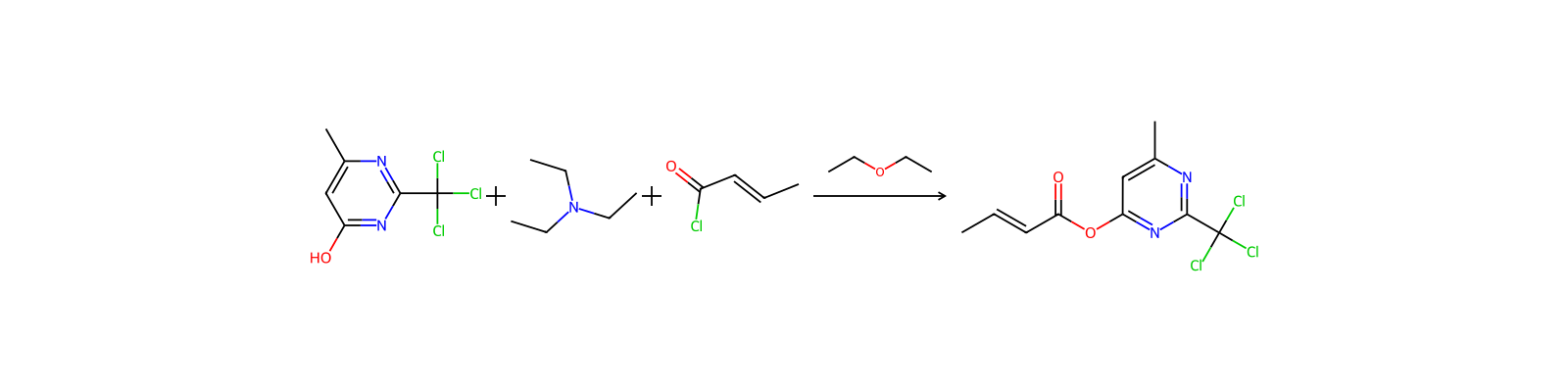
[OH:1][C:2]1[CH:7]=[C:6]([CH3:8])[N:5]=[C:4]([C:9]([Cl:12])([Cl:11])[Cl:10])[N:3]=1.C(N(CC)CC)C.[C:20](Cl)(=[O:24])/[CH:21]=[CH:22]/[CH3:23]>C(OCC)C>[C:20]([O:1][C:2]1[CH:7]=[C:6]([CH3:8])[N:5]=[C:4]([C:9]([Cl:12])([Cl:10])[Cl:11])[N:3]=1)(=[O:24])/[CH:21]=[CH:22]/[CH3:23]Participants
5
Reactant 3



Product 1

Reagents, catalysts & solvents 1

Procedure
To a solution of 3.0 g (0.02 mole) 4-hydroxy-6-methyl-2-trichloromethylpyrimidine and 1.3 g (0.02 mole) triethylamine in 75 ml diethyl ether was added 1.4 g (0.02 mole) crotonyl chloride. The reaction mixture was refluxed for 15 hours and filtered, and the filtrate was concentrated in-vacuo to give a viscous oil as residue. Trituration with petroleum ether caused the oil to solidify. Recrystallization from isopropyl alcohol gave 1.8 g (45% yield) of pure product; m.p. 55° C.
Workup
- temperatureThe reaction mixture was refluxed for 15 hours
- filtrationfiltered
- concentrationthe filtrate was concentrated in-vacuo
- customto give a viscous oil as residue
- customRecrystallization from isopropyl alcohol
Sources & evidence
- ORD record
- ord-862eea4fe61a46a7a4bd37ce9962335e
- Source dataset
- uspto-grants-1982_10
- Patent number
- US04352806
Linked notes
Loading…