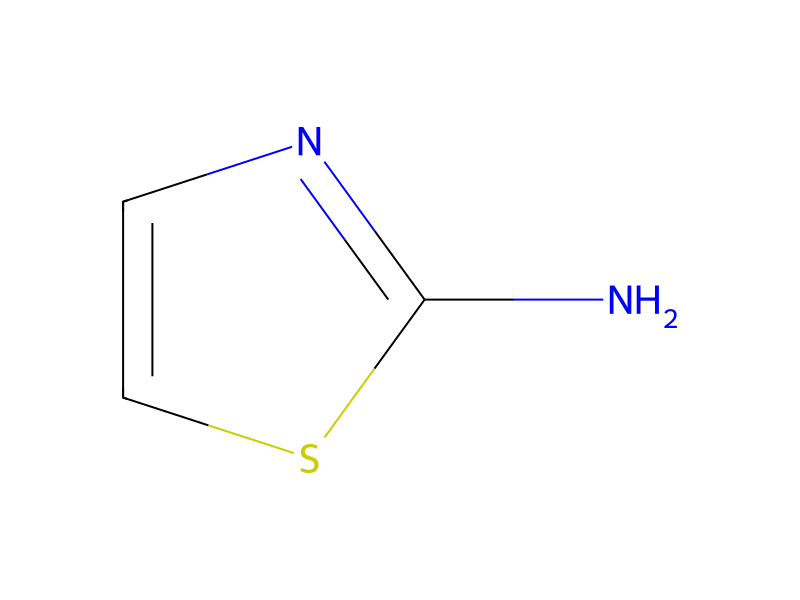
2-Aminothiazole → 1,2-dihydro-4-hydroxy-1-phenyl-N-(2-thiazolyl)-3-quinolinecarboxamide
HRID 2232102
Reaction equation

[NH2:1][C:2]1[S:3][CH:4]=[CH:5][N:6]=1.[OH:7][C:8]1[C:17]2[C:12](=[CH:13][CH:14]=[CH:15][CH:16]=2)[N:11]([C:18]2[CH:23]=[CH:22][CH:21]=[CH:20][CH:19]=2)[CH2:10][C:9]=1[C:24](OCC)=[O:25]>C1(C)C=CC=CC=1>[OH:7][C:8]1[C:17]2[C:12](=[CH:13][CH:14]=[CH:15][CH:16]=2)[N:11]([C:18]2[CH:19]=[CH:20][CH:21]=[CH:22][CH:23]=2)[CH2:10][C:9]=1[C:24]([NH:1][C:2]1[S:3][CH:4]=[CH:5][N:6]=1)=[O:25]Participants
4



Procedure
A solution of 4.08 g of 2-aminothiazole and 8.0 g of 1,2-dihydro-4-hydroxy-1-phenyl-3-quinolinecarboxylic acid, ethyl ester in 250 ml of toluene was refluxed for 30 hours in a soxhlet apparatus containing 10 g of 4 Å molecular sieves. Evaporation of the volatiles afforded a residue which was purified by means of high pressure liquid chromatography (silica gel: 1:25 ethyl acetate-dichloromethane as the eluent). The resulant solution was degassed and evaporated. Recrystallization of the residue from diethyl ether yielded 6.35 g (67%) of 1,2-dihydro-4-hydroxy-1-phenyl-N-(2-thiazolyl)-3-quinolinecarboxamide, m.p. 220° C. (dec.).