Reaction equation

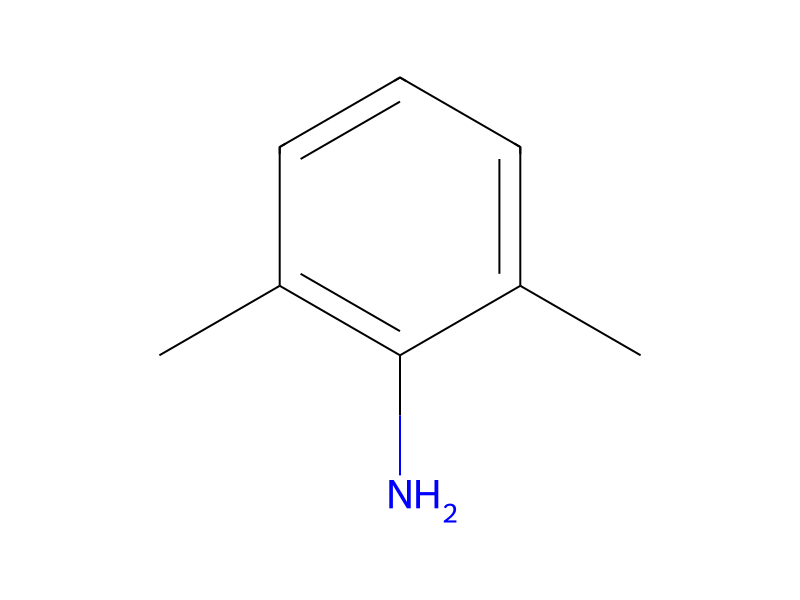
[NH3:1].[CH3:2][CH:3]1[CH2:8][CH2:7][CH2:6][CH:5]([CH3:9])[C:4]1=[O:10]>[Pd].[H][H]>[CH3:2][CH:3]1[CH2:8][CH2:7][CH2:6][CH:5]([CH3:9])[C:4]1=[O:10].[CH3:2][C:3]1[CH:8]=[CH:7][CH:6]=[C:5]([CH3:9])[C:4]=1[NH2:1]Participants
Reactant 2


Product 2
Reagents, catalysts & solvents 2


Conditions
- Temperature
- 220 °C
Procedure
A catalyst which is in the form of extrudate of 3 mm diameter and 10 mm length and which contains 1.8% by weight of palladium on a zinc-aluminum spinel as the carrier is introduced into a reactor consisting of a pressure-resistant cylindrical tube of 1.2 liters volume, and is heated to 220° C. Per hour, a gaseous mixture of 200 liters (S.T.P.) of ammonia and 200 liters (S.T.P.) of hydrogen and 100 g of vaporized 2,6-dimethylcyclohexan-1-one are passed over this catalyst bed under atmospheric pressure. The reaction product is cooled as soon as it leaves the reactor, and is distilled. 100 g of 2,6-dimethylcyclohexan-1-one give 93 g of 2,6-dimethylaniline of boiling point 216° C. at atmospheric pressure, corresponding to a yield of 97% of theory.
Workup
- additionis introduced into a reactor
- customconsisting of a pressure-resistant cylindrical tube of 1.2 liters volume
- waitPer hour
- temperatureThe reaction product is cooled as soon as it
- customleaves the reactor
- distillationis distilled
Sources & evidence
- ORD record
- ord-79dea211fd5b43fbb29e7dff98d753e4
- Source dataset
- uspto-grants-1982_10
- Patent number
- US04355180
Linked notes
Loading…