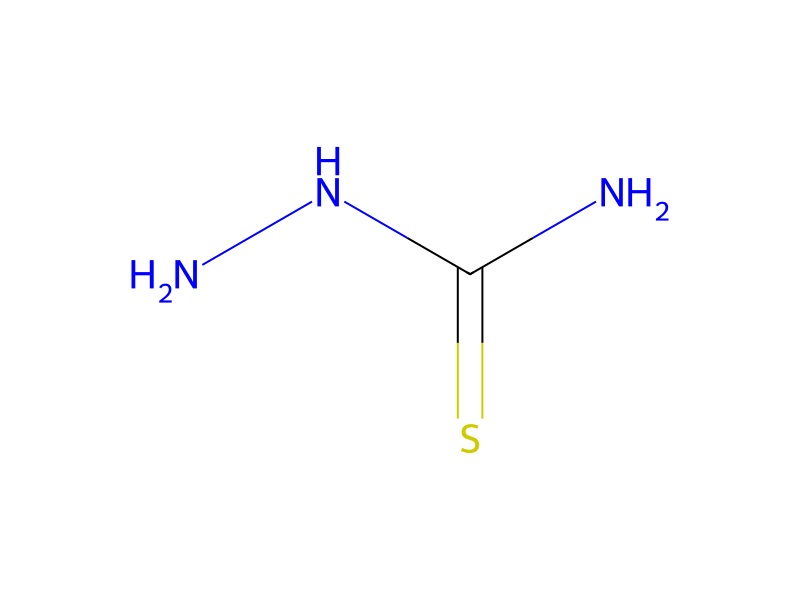
A 100 milliliter, 3-neck flask adapted with a Claisen adaptor, paddle stirrer, thermometer, an addition funnel and condenser was charged with 10.0 grams (0.050 mole) of 2-(2-chlorophenoxy)propanoic acid, (4.6 grams, 0.050 mole) of thiosemicarbazide and 30 milliliters of dioxane. The slurry was heated to 90° C. and the addition funnel was charged with phosphorous oxychloride (POCl3). The POCl3 (8.4 grams, 0.055 mole) was slowly added (for 25 minutes) while maintaining the temperature within 85°-90° C. The resulting mixture was refluxed for 75 minutes and stood at ambient temperature for 16 hours. The flask was evacuated by using a water aspirator to remove volatiles (HCl, POCl3 and some dioxane) at 60° C. and then the solution was cooled. Fifty (50) milliliters of water was added and 50 percent solution of NaOH was also added until the pH of the solution was 10; a solid precipitate formed. The solid precipitate was filtered off, washed with water, then dried in a vacuum oven at 80° C. to 9.8 grams of white crystals of 5-[1-(2-chlorophenoxy)ethyl]-2-amino-1,3,4-thiadiazole. (Melting point 160°-164° C.).