HomeMCPWorkbenchSkills
HomeWorkbenchNotificationsMe
llms.txt · MCP GuidePrivacy Policy · Terms of Service · Supportv1.8.0
  1. Home
  2. /Reaction

Acetic Acid → 6-[2-Formyl-5-(hydroxymethyl)-1H-pyrrol-1-yl]hexanoic acid

HRID 2293015
Notes
Print preview

Reaction equation

HRID 2293015 reaction equation
O=C[C@@H]([C@H]([C@@H]([C@@H](CO)O)O)O)O.NCCCCCC(O)=O.C(O)(=O)C.[CH:26]1[CH:30]=[C:29]([CH:31]=[O:32])[N:28]([CH2:33][CH2:34][CH2:35][CH2:36][C@H:37](N)[C:38]([OH:40])=[O:39])[C:27]=1[CH2:42][OH:43]>O>[CH:42]([C:27]1[N:28]([CH2:33][CH2:34][CH2:35][CH2:36][CH2:37][C:38]([OH:40])=[O:39])[C:29]([CH2:31][OH:32])=[CH:30][CH:26]=1)=[O:43]
ParticipantsConditionsProcedureWorkupSources & evidenceReaction notes

Participants

6

Reactant 4

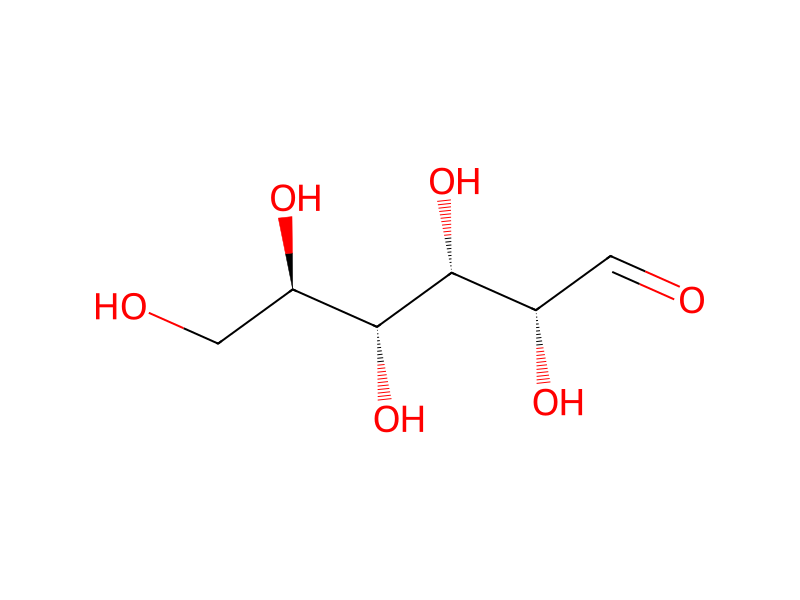
HCID 176Acetic AcidHCID 5646-Aminohexanoic AcidHCID 107526(2R,3S,4R,5R)-2,3,4,5,6-pentahydroxyhexanalHCID 122228Pyrraline

Product 1

HCID 214756696-[2-Formyl-5-(hydroxymethyl)-1H-pyrrol-1-yl]hexanoic acid

Reagents, catalysts & solvents 1

HCID 962
Water
Solvent

Conditions

Temperature
100 °C

Procedure

Structure 8b was prepared according to the method described by F. Hayase et al., J. Biol. Chem 263: 3758-64 (1989). The procedure was approximately as follows: ε-(2-Formyl-5-hydroxymethyl-pyrrol-1-yl)-caproic Acid (Caproyl Pyrraline or structure 8b) was synthesized for use as a hapten. D-Glucose (18 g) and ε-amino caproic acid (13.1 g) were dissolved in distilled water (20 mL), and the pH was adjusted to 4.0 with acetic acid. The solution was refluxed at 100° C. for 3 h. The resulting brown solution was extracted with ethyl acetate, dried with anhydrous sodium sulfate, and concentrated. The concentrate was charged onto a silica gel column for flash chromatography in 3:1 hexane/ethyl acetate. 2,4-Dinitrophenylhydrazine-positive fractions containing caproyl pyrraline were collected and recrystallized from ether/hexane. The yield was 1 g. Proton NMR: (CDCl3) δ 1.33-1.92 (m, 6H, 3×CH2), 2.39 (t 2H, CH2), 4.33 (t, 2H, CH2), 4.72 (s, 2H, CH2OH), 6.23 (d, 1H, pyrrole-4H), 6.99 (d, 1H, pyrrole-3H), 9.46 (s, 1H, CHO). IR 3500, 2950-2860 (br), 1725, 1645, and 1400 cm-1. UVmax 297 nm (H2O) (ε=1.61×10⁴ mol-1 liter cm-2). Chemical ionization mass spectrometry-millimass: C12H17O4N as theoretical ion distribution, M1 =239 1158. Mass spectrometry analysis was performed with a HP 5985A mass spectrometer Crlewlett-Packard). Chemical ionization mass spectrometry was analyzed with methane as the reaction gas. NMR, IR, and UV properties were identical with those of synthetic neopentyl and L-lysyl pyrraline.


Workup

  1. customStructure 8b was prepared
  2. extractionThe resulting brown solution was extracted with ethyl acetate
  3. dry with materialdried with anhydrous sodium sulfate
  4. concentrationconcentrated
  5. additionThe concentrate was charged onto a silica gel column for flash chromatography in 3:1 hexane/ethyl acetate
  6. addition2,4-Dinitrophenylhydrazine-positive fractions containing caproyl pyrraline
  7. customwere collected
  8. customrecrystallized from ether/hexane
  9. customChemical ionization mass spectrometry was analyzed with methane as the reaction gas

Sources & evidence

ORD record
ord-e67ac3e1a1df4f65b3b5fe8b896ed217
Source dataset
uspto-grants-1997_11
DOI
10.6084/m9.figshare.5104873.v1
Patent number
US05686250

Reaction notes

Loading…

On this pageParticipantsConditionsProcedureWorkupSources & evidenceReaction notes