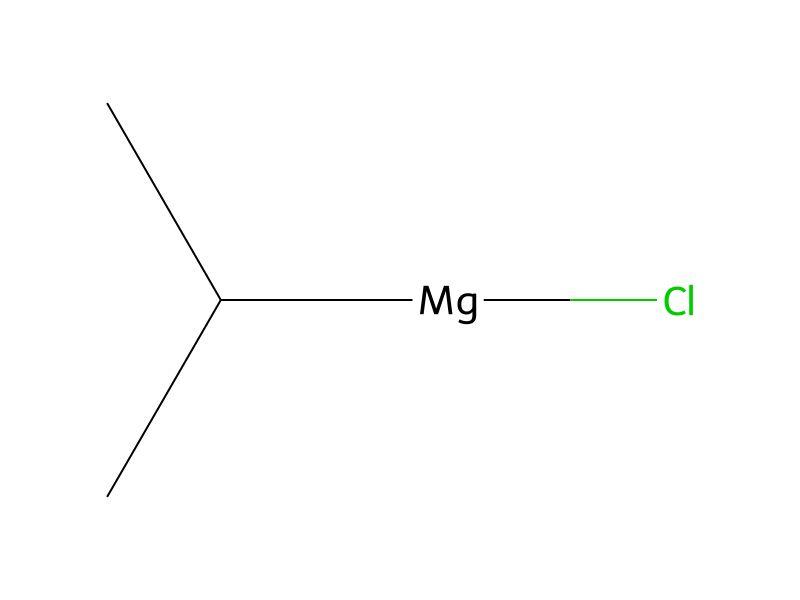
Br[C:2]1[C:3]([O:17][C:18]2[CH:23]=[CH:22][C:21]([F:24])=[CH:20][C:19]=2[F:25])=[N:4][C:5]([O:8][C:9]2[CH:14]=[CH:13][C:12]([F:15])=[CH:11][C:10]=2[F:16])=[N:6][CH:7]=1.C([Mg]Cl)(C)C.[C:31](Cl)(=[O:36])[CH2:32][CH:33]([CH3:35])[CH3:34]>C1COCC1>[F:16][C:10]1[CH:11]=[C:12]([F:15])[CH:13]=[CH:14][C:9]=1[O:8][C:5]1[N:4]=[C:3]([O:17][C:18]2[CH:23]=[CH:22][C:21]([F:24])=[CH:20][C:19]=2[F:25])[C:2]([C:31](=[O:36])[CH2:32][CH:33]([CH3:35])[CH3:34])=[CH:7][N:6]=15-Bromo-2,4-bis-(2,4-difluoro-phenoxy)-pyrimidine (0.5 g, 1.2 mmol) was dissolved in 25 mL THF and cooled to 0° C. Isopropyl magnesium chloride (0.8 mL, 1.44 mmol) was added, and the reaction mixture was stirred for an hour at 0° C. Isovaleryl chloride (1.47 mL, 12.0 mmol) was then added, and the reaction mixture was stirred for another hour at 0° C. The reaction was quenched with 35 mL of saturated aqueous sodium bicarbonate and 25 mL water. The aqueous mixture was extracted three times with 25 mL EtOAc, and the combined organic layers were washed with saturated aqueous brine, dried (Na2SO4), filtered, and evaporated under reduced pressure. The residue was eluted through silica gel using 20% EtOAc in hexanes to yield 0.429 g (85%) of 1-[2,4-bis-(2,4-difluoro-phenoxy)-pyrimidin-5-yl]-3-methyl-butan-1-one. Mass Spec. M+H=421.