Reaction equation

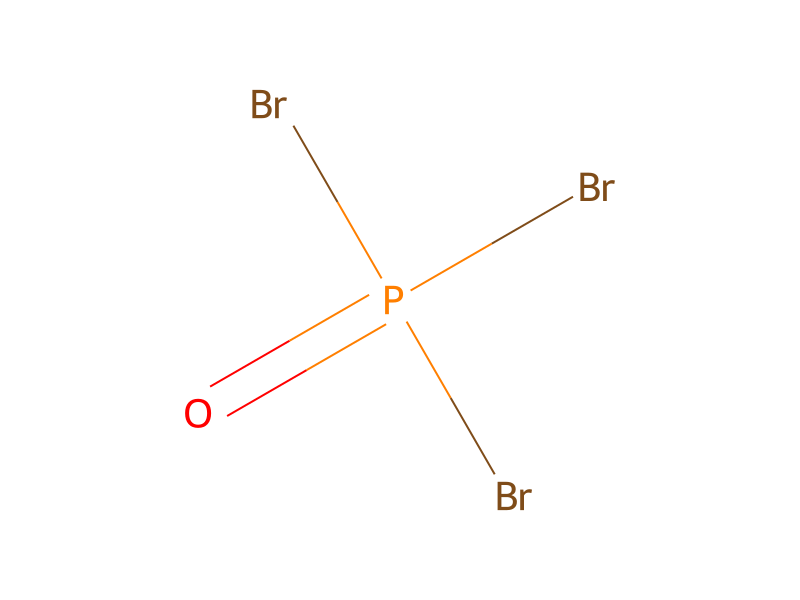
[N+:1]([C:4]1[C:13]2[C:8](=[CH:9][CH:10]=[CH:11][CH:12]=2)[N+:7]([O-])=[CH:6][CH:5]=1)([O-:3])=[O:2].P(Br)(Br)([Br:17])=O.[OH-].[Na+]>C(Cl)(Cl)Cl.C(Cl)Cl>[Br:17][C:6]1[CH:5]=[C:4]([N+:1]([O-:3])=[O:2])[C:13]2[C:8](=[CH:9][CH:10]=[CH:11][CH:12]=2)[N:7]=1Participants
6
Reactant 3


Product 1

Reagents, catalysts & solvents 2


Conditions
- Temperature
- 0 °C
Procedure
4-Nitroquinoline 1-oxide (940 mg, 4.9 mmol) in chloroform (12 mL) was cooled to 0° C. To this solution, POBr3 (1.77 g, 6.2 mmol) was added in small portions. The mixture was stirred at 0° C. for 2 h and diluted with DCM (50 mL), and poured on ice (50 g). To this suspension, 1 M NaOH was added to adjust pH to about 9. Layers were separated and the organic layer was washed with water (2×50 mL) and dried over MgSO4 and concentrated. The crude product was purified by silica chromatography to afford 2-bromo-4-nitroquinoline as a yellow solid (620 mg, 50%). 1H NMR (400 MHz, CDCl3): δ 7.63-7.94 (m, 2H), 8.06 (s, 1H), 8.17 (t, J=7.16, 6.84 Hz, 1H), 8.38 (d, J=8.76 Hz, 1H).
Workup
- additionpoured on ice (50 g)
- customLayers were separated
- washthe organic layer was washed with water (2×50 mL)
- dry with materialdried over MgSO4
- concentrationconcentrated
- customThe crude product was purified by silica chromatography
Sources & evidence
- ORD record
- ord-c1ca6e88437c404288dd98396bfecc88
- Source dataset
- uspto-grants-2014_04
- Patent number
- US08691187B2
Linked notes
Loading…