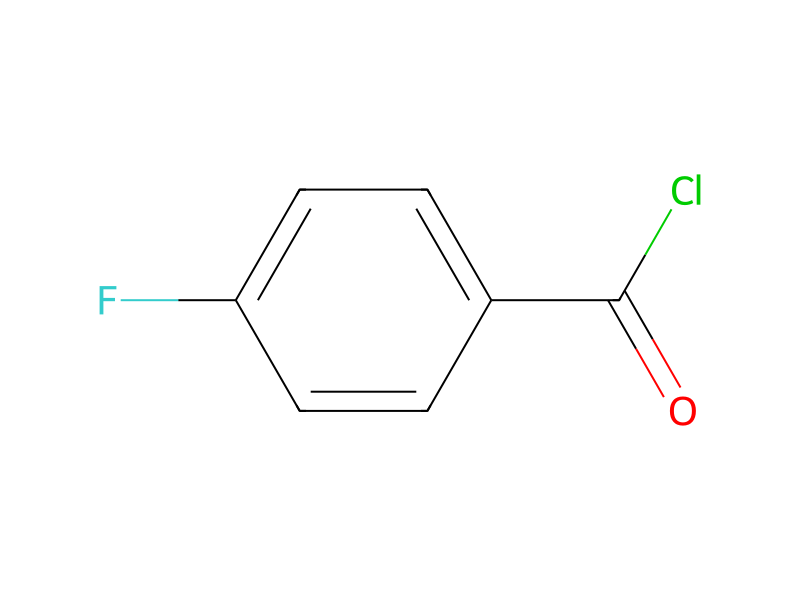
A flask containing 2-amino-2-methyl-propionic acid (500 mg, 4.85 mmol) and sodium bicarbonate (1.29 g, 12.12 mmol) in water (10 mL) and acetone (1 mL) was chilled to 5° C. In a dropwise manner 4-fluoro-benzoyl chloride (0.688 mL, 5.82 mmol) was added. After stirring for 1 hr the mixture was allowed to warm to room temperature. After stirring for an additional 16 hr, the reaction was washed with toluene (2 mL). The aqueous portion was removed and the mixture filtered. The filtrate was partitioned and the organic layer removed. The collected solid was solubulized in water (10 mL) and all the aqueous phases combined. The pH of the combined aqueous was adjusted to 3 by slow addition of 1N HCl, and the acidified mixture was extracted with EtOAc (3×30 mL). The combined organics were washed with brine (20 mL) and dried over Na2SO4. Evaporation of the solvent resulted in a white solid. The solid was heated to 50° C. in Ac2O (2.9 mL) and toluene (0.82 mL) for 2 hr. The reaction was concentrated and azeotroped with HEP. The resulting residue was dissolved in Et2O (65 mL) and extracted with NaHCO3 (15 mL) followed by brine (10 mL). After drying over Na2SO4, the solvent was envaporated to afford the title compound as a white solid: Rt (method A)=1.22 min (M+H)+=208.3.