Isobutylamine → 4-Isobutyl-3-nitro quinoline
Reaction equation
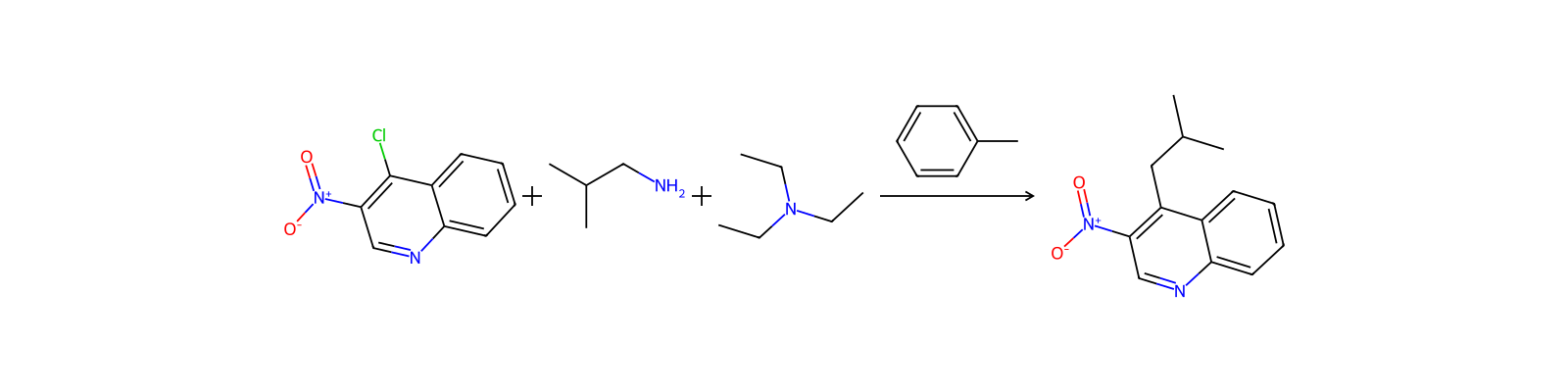
Cl[C:2]1[C:11]2[C:6](=[CH:7][CH:8]=[CH:9][CH:10]=2)[N:5]=[CH:4][C:3]=1[N+:12]([O-:14])=[O:13].[CH2:15](N)[CH:16]([CH3:18])[CH3:17].C(N(CC)CC)C>C1(C)C=CC=CC=1>[CH2:15]([C:2]1[C:11]2[C:6](=[CH:7][CH:8]=[CH:9][CH:10]=2)[N:5]=[CH:4][C:3]=1[N+:12]([O-:14])=[O:13])[CH:16]([CH3:18])[CH3:17]Participants
5
Reactant 3



Product 1

Reagents, catalysts & solvents 1

Procedure
4-chloro-3-nitro-quinoline is reacted with isobutyl amine in the presence of triethylamine (TEA) at between −10 and +15° C. in toluene, while excluding moisture. After washing and phase separation, the organic solution is ready for the next step.
Workup
- washAfter washing
- customphase separation
Sources & evidence
- ORD record
- ord-36905fa681b1473c9ca583a21c17dc15
- Source dataset
- uspto-grants-2005_02
- Patent number
- US06852861B2
Reaction notes
Loading…