Reaction equation

[CH3:1][O:2][C:3]1[CH:8]=[C:7]2[C:9]([NH2:26])=[N:10][C:11]([N:13]3[CH2:18][CH2:17][N:16]([C:19]([CH:21]4[O:25][CH2:24][CH2:23][CH2:22]4)=[O:20])[CH2:15][CH2:14]3)=[N:12][C:6]2=[CH:5][C:4]=1[O:27][CH3:28].O.O.Cl>C(O)C>[CH3:1][O:2][C:3]1[CH:8]=[C:7]2[C:9]([NH2:26])=[N:10][C:11]([N:13]3[CH2:18][CH2:17][N:16]([C:19]([CH:21]4[O:25][CH2:24][CH2:23][CH2:22]4)=[O:20])[CH2:15][CH2:14]3)=[N:12][C:6]2=[CH:5][C:4]=1[O:27][CH3:28]Participants
3
Reactant 1

Product 1
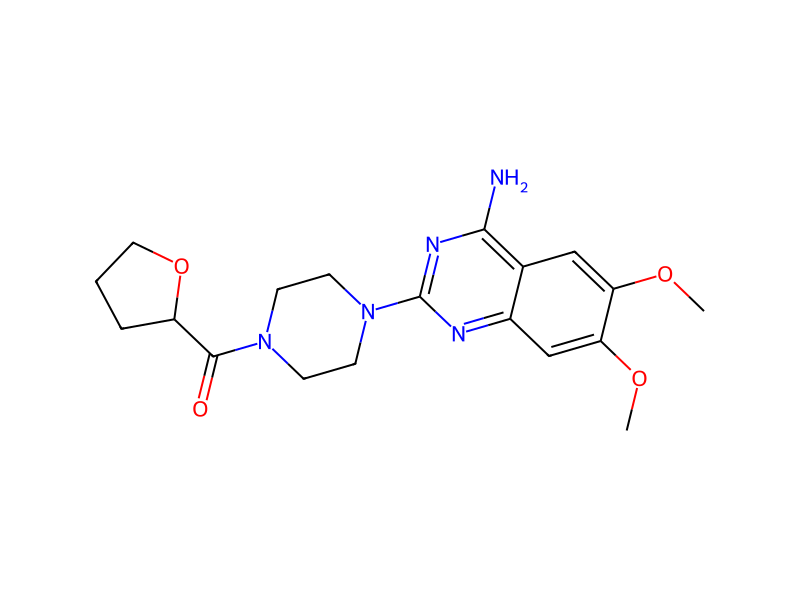
Reagents, catalysts & solvents 1

Procedure
Terazosin monohydrochloride dihydrate (620 mg, 1.35 mmol) was dissolved in 100 mL of hot absolute ethanol in a 250 mL Erlenmeyer flask fitted with a ground glass joint. The solution was slowly cooled to room temperature and allowed to stand overnight. The resulting white crystalline precipitate was collected by vacuum filtration to yield 100 mg (0.24 mmol, 17.4%) of the anhydrous crystalline polymorph of terazosin of this invention. The material was found by its powder x-ray diffraction pattern to be free of both the prior art anhydrous crystalline modification and the dihydrate form.
Workup
- customfitted with a ground glass joint
- filtrationThe resulting white crystalline precipitate was collected by vacuum filtration
Sources & evidence
- ORD record
- ord-d59d9fb764014b84b9b64fb74483d498
- Source dataset
- uspto-grants-1994_11
- Patent number
- US05362730
Linked notes
Loading…