HomeMCPWorkbenchSkills
HomeWorkbenchNotificationsMe
llms.txt · MCP GuidePrivacy Policy · Terms of Service · Supportv1.8.3
  1. Home
  2. /Reaction

Hydrochloric Acid → 7-bromo-5-hydroxy-3,4-dihydro-2H-naphthalen-1-one

HRID 2383998
Print

Reaction equation

HRID 2383998 reaction equation
C(P(C(C)(C)C)C1C=CC=CC=1C1C(C(C)C)=CC(C(C)C)=CC=1C(C)C)(C)(C)C.[OH-:31].[K+].Br[C:34]1[CH:43]=[C:42]([Br:44])[CH:41]=[C:40]2[C:35]=1[CH2:36][CH2:37][CH2:38][C:39]2=[O:45].Cl>O1CCOCC1.O.C1C=CC(/C=C/C(/C=C/C2C=CC=CC=2)=O)=CC=1.C1C=CC(/C=C/C(/C=C/C2C=CC=CC=2)=O)=CC=1.C1C=CC(/C=C/C(/C=C/C2C=CC=CC=2)=O)=CC=1.[Pd].[Pd]>[Br:44][C:42]1[CH:41]=[C:40]2[C:35]([CH2:36][CH2:37][CH2:38][C:39]2=[O:45])=[C:34]([OH:31])[CH:43]=1
ParticipantsConditionsProcedureWorkupSources & evidenceReaction notes

Participants

8

Reactant 4

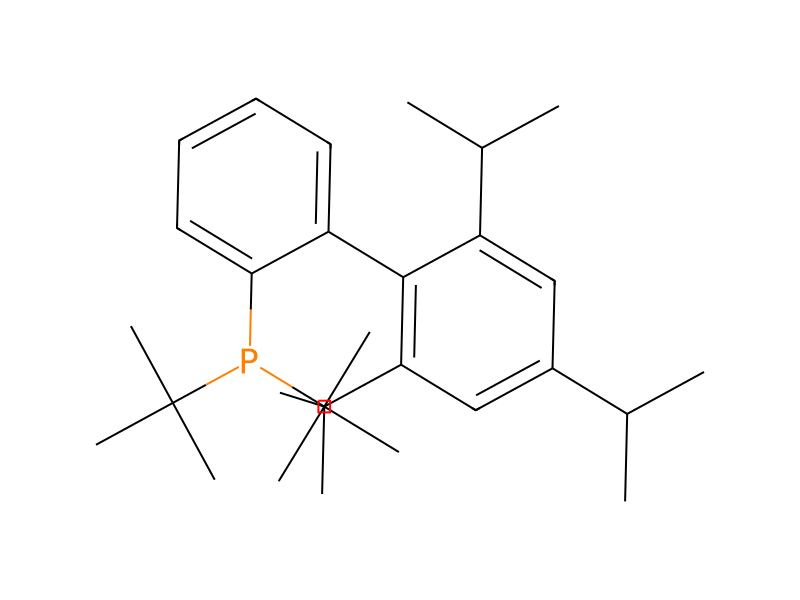
HCID 313Hydrochloric AcidHCID 14797Potassium HydroxideHCID 103802865,7-dibromo-3,4-dihydronaphthalen-1(2H)-oneHCID 11618717Di-tert-butyl(2',4',6'-tris(propan-2-yl)-(1,1'-biphenyl)-2-yl)phosphane

Product 1

HCID 591925237-bromo-5-hydroxy-3,4-dihydro-2H-naphthalen-1-oneYield 16.2%

Reagents, catalysts & solvents

3
HCID 9811564Bis(dibenzylideneacetone)palladiumCatalystHCID 962WaterSolventHCID 312751,4-DioxaneSolvent

Conditions

Temperature
100 °C

Procedure

To a mixture of tris(dibenzylideneacetone)dipalladium(0) (210 mg, 0.23 mmol), di-tert-butyl-(2′,4′,6′-triisopropyl-biphenyl-2-yl)-phosphane (403 mg, 0.92 mmol), and potassium hydroxide (1.67 g, 25.32 mmol) were added degassed water (5.25 mL) and a solution of 5,7-dibromo-3,4-dihydro-2H-naphthalen-1-one (3.5 g, 11.51 mmol) in dioxane (7.0 mL) at room temperature under nitrogen. The resulting suspension was heated to 100° C. for 3.5 h. The reaction mixture was then cooled to room temperature, diluted with water (˜10 mL) and acidified with 1N HCl solution. The resulting mixture was extracted with ethyl acetate (2×100 mL) and the combined organic extracts were washed with brine (200 mL), then dried over anhydrous magnesium sulfate, filtered, and concentrated in vacuo. The crude product was purified by chromatography, using an ISCO (120 g) column (gradient elution with 5-30% ethyl acetate in hexanes) to obtain 7-bromo-5-hydroxy-3,4-dihydro-2H-naphthalen-1-one (0.45 g, 16%) as a white solid: ES(−)-HRMS m/e calcd. (calculated) for C10H9O2Br (M−H)− 238.9713, obsd. (observed) 238.9712. Two other side products were also isolated and characterized as 5-bromo-7-hydroxy-3,4-dihydro-2H-naphthalen-1-one (0.3 g, 10%) and 5,7-dihydroxy-3,4-dihydro-2H-naphthalen-1-one (0.191 g, 7%).


Workup

  1. additionwere added
  2. customdegassed water (5.25 mL)
  3. customat room temperature
  4. temperatureThe reaction mixture was then cooled to room temperature
  5. extractionThe resulting mixture was extracted with ethyl acetate (2×100 mL)
  6. washthe combined organic extracts were washed with brine (200 mL)
  7. dry with materialdried over anhydrous magnesium sulfate
  8. filtrationfiltered
  9. concentrationconcentrated in vacuo
  10. customThe crude product was purified by chromatography
  11. washan ISCO (120 g) column (gradient elution with 5-30% ethyl acetate in hexanes)

Sources & evidence

ORD record
ord-9a6e199320ca4122af4ae912527f55a4
Source dataset
uspto-grants-2012_09
DOI
10.6084/m9.figshare.5104873.v1
Patent number
US08263656B2

Reaction notes

On this pageParticipantsConditionsProcedureWorkupSources & evidenceReaction notes