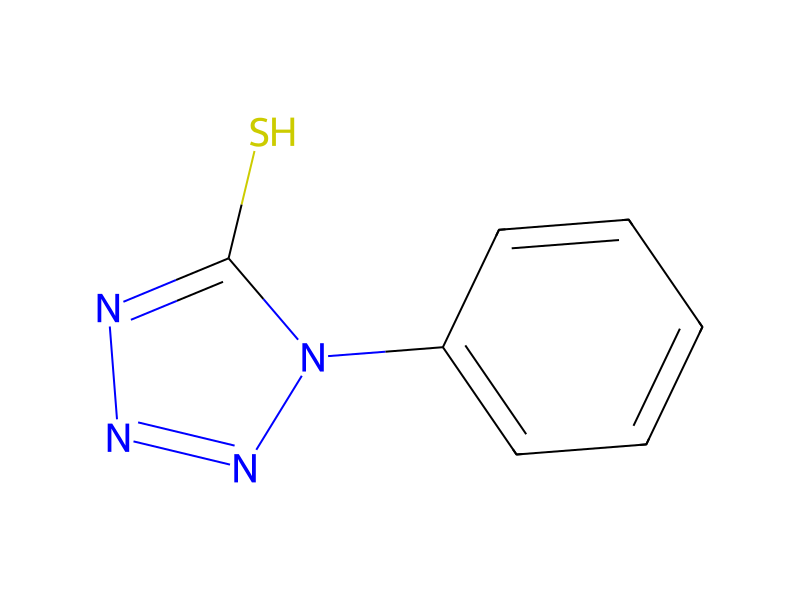
[C:1]1([N:7]2[C:11]([SH:12])=[N:10][N:9]=[N:8]2)[CH:6]=[CH:5][CH:4]=[CH:3][CH:2]=1.Cl[CH2:14][N:15]1[S:19](=[O:21])(=[O:20])[N:18]2[CH2:22][CH2:23][CH2:24][CH:17]2[C:16]1=[O:25]>CN(C=O)C>[C:1]1([N:7]2[C:11]([S:12][CH2:14][N:15]3[S:19](=[O:21])(=[O:20])[N:18]4[CH2:22][CH2:23][CH2:24][CH:17]4[C:16]3=[O:25])=[N:10][N:9]=[N:8]2)[CH:2]=[CH:3][CH:4]=[CH:5][CH:6]=1The Na salt of 1-phenyl-5-mercapto-1H-tetrazole (0.57 g) was added to a solution of 2-chloromethyl-tetrahydropyrrolo[1,2-b]-1,2,5-thiadiazol-3 (2H)-one 1,1-dioxide (0.5 g) in DMF (10 ml) at room temperature, and the mixture was allowed to react at 60° C. for 6 hours and then cooled. The mixture was poured into ice/water containing saturated sodium bicarbonate, extracted with ethyl acetate, and the organic layer was washed with water, brine, and dried over sodium sulfate. The solvent was concentrated in vacuo and the residue was purified by silica gel flash chromatography (40% ethyl acetate/hexane) to afford 0.69 g of 2-(1-phenyl-1H-tetrazol-5-yl-thiomethyl)tetrahydropyrrolo[1,2-b]-1,2,5-thiadiazol-3 (2H)-one 1,1-dioxide (Formula I: R4 =1-phenyl-1H-tetrazol-5-yl; X=S; R1 =H; R2 and R3 together=--(CH2)3 --) as a solid, m.p.99.5°-100.5° C.