HomeMCPSkillsWorkbenchOpenChem
HomeWorkbenchNotificationsMe
llms.txt · skill.md · MCP GuidePrivacy Policy · Terms of Service · Supportv1.8.4
  1. Home
  2. /Reaction

Ammonia → 6-{[2-(3-chloro-pyridin-2-yl)-5-trifluoromethyl-2H-pyrazole-3-carbonyl]-amino}-2,7-dimethyl-quinoline-5-carboxylic acid isopropylamide

HRID 245610
Print

Reaction equation

[NH2:1][C:2]1[CH:7]=[C:6]([C:8]([NH:10][CH:11]([CH3:13])[CH3:12])=[O:9])[C:5]([NH:14][C:15]([C:17]2[N:21]([C:22]3[C:27]([Cl:28])=[CH:26][CH:25]=[CH:24][N:23]=3)[N:20]=[C:19]([C:29]([F:32])([F:31])[F:30])[CH:18]=2)=[O:16])=[C:4]([CH3:33])[CH:3]=1.[CH:34](=O)/[CH:35]=[CH:36]/[CH3:37].N>[Cl-].C([N+](CC)(CC)CC)C1C=CC=CC=1.Cl.C1(C)C=CC=CC=1.C(OCC)(=O)C.O1CCCC1>[CH:11]([NH:10][C:8]([C:6]1[C:7]2[CH:34]=[CH:35][C:36]([CH3:37])=[N:1][C:2]=2[CH:3]=[C:4]([CH3:33])[C:5]=1[NH:14][C:15]([C:17]1[N:21]([C:22]2[C:27]([Cl:28])=[CH:26][CH:25]=[CH:24][N:23]=2)[N:20]=[C:19]([C:29]([F:32])([F:31])[F:30])[CH:18]=1)=[O:16])=[O:9])([CH3:13])[CH3:12]
ParticipantsProcedureWorkupSources & evidenceReaction notes

Participants

8

Reactant 3

HCID 222AmmoniaHCID 447466CrotonaldehydeHCID 10227689N-(4-amino-2-methyl-6-(((1-methylethyl)amino)carbonyl)phenyl)-1-(3-chloro-2-pyridinyl)-3-(trifluoromethyl)-1H-pyrazole-5-carboxamide

Product 1

HCID 579901216-{[2-(3-chloro-pyridin-2-yl)-5-trifluoromethyl-2H-pyrazole-3-carbonyl]-amino}-2,7-dimethyl-quinoline-5-carboxylic acid isopropylamide

Reagents, catalysts & solvents 4

HCID 66133
Benzyl triethylammonium chloride
Catalyst
HCID 313Hydrochloric AcidSolvent
HCID 1140TolueneSolvent
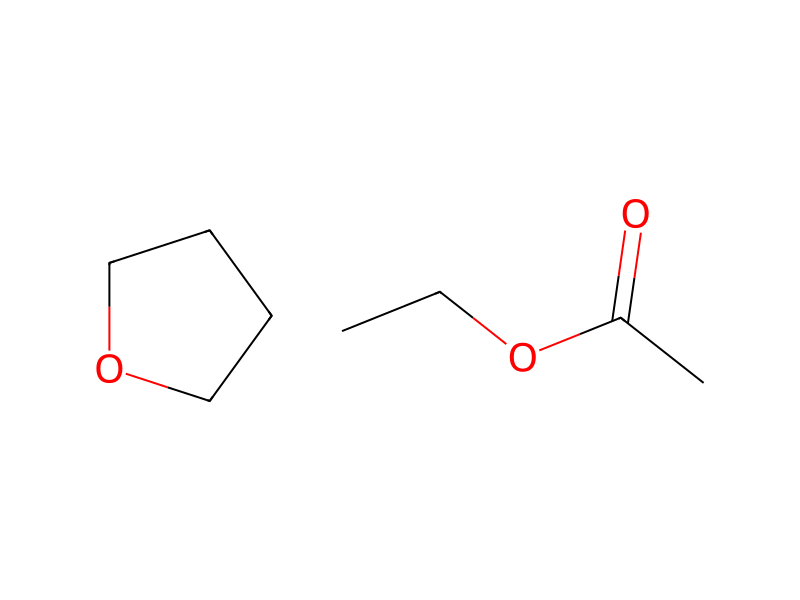
HCID 21939870Tetrahydrofuran ethyl acetateSolvent

Procedure

1.70 g (3.53 mMol) N-(4-amino-2-methyl-6-(((1-methylethyl)amino)carbonyl)phenyl)-1-(3-chloro-2-pyridinyl)-3-(trifluoromethyl)-1H-pyrazole-5-carboxamide (known from WO 03/016284) and 41 mg (0.18 mmol) benzyltriethylammonium chloride in 35 mL conc. HCl and 35 mL toluene are vigorously stirred at 60° C. Then 0.58 mL (7 mmol) crotonaldehyde is added and the reaction mixture is stirred under reflux during 1 hour. The mixture is then cooled to ambient temperature, diluted with 10 mL ethyl acetate/tetrahydrofuran (1:1, v/v) and neutralised with an aqueous solution of concentrated ammonia. The organic phase is extracted and washed once with brine, then dried on Na2SO4, filtrated and evaporated. After column chromatography purification on silica gel with dichloromethane/tetrahydrofuran (3:1) as eluents, the compound is recrystallised from tetrahydrofuran/hexane to afford a colourless solid; LC/MS:531/533 (M+H)+, m.p.: >240° C.

Workup

  1. temperatureunder reflux during 1 hour
  2. extractionThe organic phase is extracted
  3. washwashed once with brine
  4. customdried on Na2SO4
  5. filtrationfiltrated
  6. customevaporated
  7. customAfter column chromatography purification on silica gel with dichloromethane/tetrahydrofuran (3:1) as eluents
  8. customthe compound is recrystallised from tetrahydrofuran/hexane
  9. customto afford a colourless solid

Sources & evidence

ORD record
ord-a7c237c0c47946b1910931cdc8a235d7
Source dataset
uspto-grants-2014_02
DOI
10.6084/m9.figshare.5104873.v1
Patent number
US08658801B2

Reaction notes

On this pageParticipantsProcedureWorkupSources & evidenceReaction notes