Reaction equation

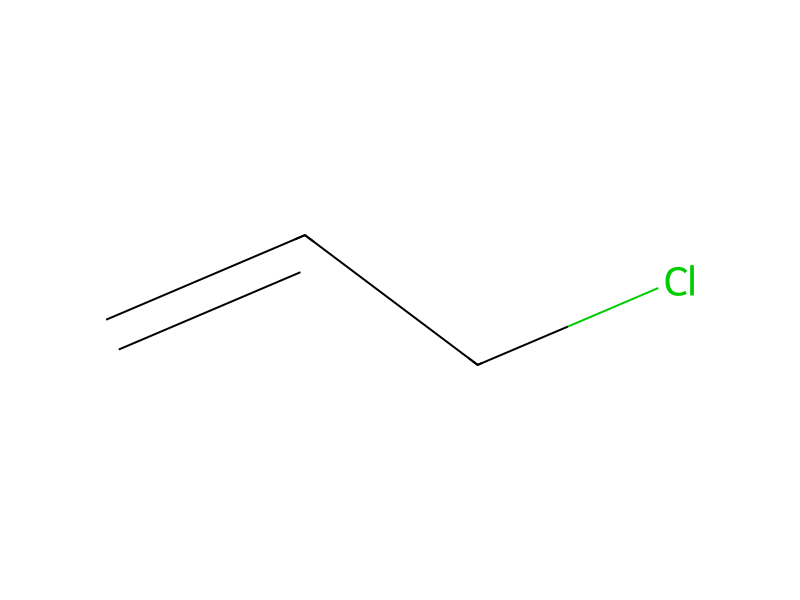
[CH2:1](Cl)[CH:2]=[CH2:3].[OH:5][CH2:6][CH:7]([C:9]1[O:10][CH2:11][CH2:12][N:13]=1)[CH3:8].[N+](C(C)(C)C)(C(C)(C)C)(C(C)(C)C)C(C)(C)C.[O-]S(O)(=O)=O.[OH-].[Na+].[Na+].[Cl-]>O1CCCC1.O.CCCCCCC>[CH2:1]([O:5][CH2:6][CH:7]([C:9]1[O:10][CH2:11][CH2:12][N:13]=1)[CH3:8])[CH:2]=[CH2:3]Participants
Reactant 5




Product 1

Reagents, catalysts & solvents 3



Procedure
In a three-neck round bottom flask, 24 g allylchloride (0.31 mole), 60 g 2-(3-hydroxy-2-propyl)-2-oxazoline (0.47 mole), 10 g of heptane, and 3.7 g (t-Bu)4NHSO4 phase transfer catalyst in 150 g tetrahydrofuran (THF) are added as the organic phase. The aqueous phase is 93 g NaOH solution prepared by dissolving 50 wt % NaOH into H2O saturated with NaCl. The solution is agitated vigorously by a mechanical stirrer. Reaction is conducted at 40° C. for 3.5 hours. Conversion is over 90% according to GC analysis of crude product. After the reaction, the aqueous layer is decanted and the organic layer is extracted four times with H2O saturated with NaCl. Tetrahydrofuran solvent is stripped off by a rotary evaporator. The remaining solution is filtered and dried over 3 Å molecular sieve. A pure monomer (99%) is obtained by distillation (0.12 mm/31° C.). The structure is identified by NMR and IR analysis.
Workup
- customprepared
- customReaction
- customAfter the reaction
- customthe aqueous layer is decanted
- extractionthe organic layer is extracted four times with H2O saturated with NaCl
- customTetrahydrofuran solvent is stripped off by a rotary evaporator
- filtrationThe remaining solution is filtered
- customdried over 3 Å molecular sieve
Sources & evidence
- ORD record
- ord-8c40477f8f3e4d22a22a90531e97a99b
- Source dataset
- uspto-grants-1987_11
- Patent number
- US04709039
Linked notes
Loading…