L-Tartaric acid → Isofagomine L(+)-Tartrate
Reaction equation

[C:1]([OH:10])(=[O:9])[C@@H:2]([C@H:4]([C:6]([OH:8])=[O:7])[OH:5])[OH:3].[CH2:11]1[NH:16][CH2:15][C@@H:14]([OH:17])[C@H:13]([OH:18])[C@H:12]1[CH2:19][OH:20]>O>[CH2:11]1[NH:16][CH2:15][C@@H:14]([OH:17])[C@H:13]([OH:18])[C@H:12]1[CH2:19][OH:20].[C:6]([C@@H:4]([C@H:2]([C:1]([O-:10])=[O:9])[OH:3])[OH:5])([O-:8])=[O:7]Participants
4
Reactant 2
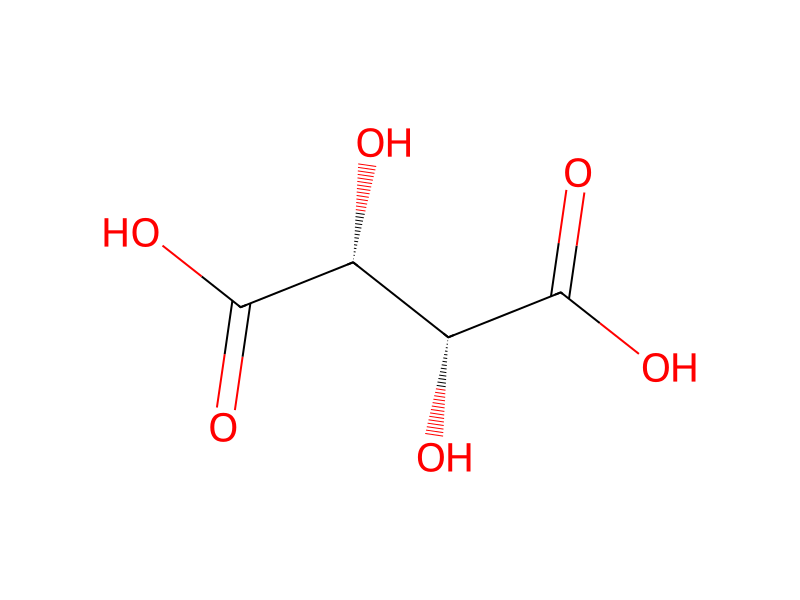

Product 1

Reagents, catalysts & solvents 1

Procedure
A solution of L-(+)-tartaric acid (102 mg, 0.679 mmol) in deionized water (1.0 mL) was added into the solution of isofagomine (200 mg, 2.0 equivalents) dissolved in deionized water (2.0 mL) at room temperature. The solution was stirred for 10 min and lyophilized overnight. The residue was further dried under vacuum at 45° C. for three days to afford the desired salt (275.6 mg, 91%). m.p. 92-93° C., 1H NMR (300 MHz, D2O): δ 4.22 (s, 2H), 3.71 (dd, J=12, 3.6 Hz, 1H), 3.67-3.59 (m, 2H), 3.44-3.37 (m, 3H), 2.85 (t, J=12 Hz, 1H), 2.75 (t, J=12 Hz, 1H), 1.85 (m, 1H) (FIG. 8A)