HomeMCPWorkbenchSkills
HomeWorkbenchNotificationsMe
llms.txt · MCP GuidePrivacy Policy · Terms of Service · Supportv1.8.3
  1. Home
  2. /Reaction

Sodium triacetoxyborohydride → 1-(2-{4-[(2,3-Dihydro[1,4]dioxino[2,3-c]pyridin-7-ylmethyl)amino]piperidin-1-yl}ethyl)-7-methoxyquinolin-2(1H)-one

HRID 255157
Print

Reaction equation

HRID 255157 reaction equation
[NH2:1][CH:2]1[CH2:7][CH2:6][N:5]([CH2:8][CH2:9][N:10]2[C:19]3[C:14](=[CH:15][CH:16]=[C:17]([O:20][CH3:21])[CH:18]=3)[CH:13]=[CH:12][C:11]2=[O:22])[CH2:4][CH2:3]1.[O:23]1[C:32]2[CH:31]=[C:30]([CH:33]=O)[N:29]=[CH:28][C:27]=2[O:26][CH2:25][CH2:24]1.C(O[BH-](OC(=O)C)OC(=O)C)(=O)C.[Na+]>C(Cl)(Cl)Cl.CO>[O:23]1[C:32]2[CH:31]=[C:30]([CH2:33][NH:1][CH:2]3[CH2:7][CH2:6][N:5]([CH2:8][CH2:9][N:10]4[C:19]5[C:14](=[CH:15][CH:16]=[C:17]([O:20][CH3:21])[CH:18]=5)[CH:13]=[CH:12][C:11]4=[O:22])[CH2:4][CH2:3]3)[N:29]=[CH:28][C:27]=2[O:26][CH2:25][CH2:24]1
ParticipantsConditionsProcedureWorkupSources & evidenceReaction notes

Participants

5

Reactant 3

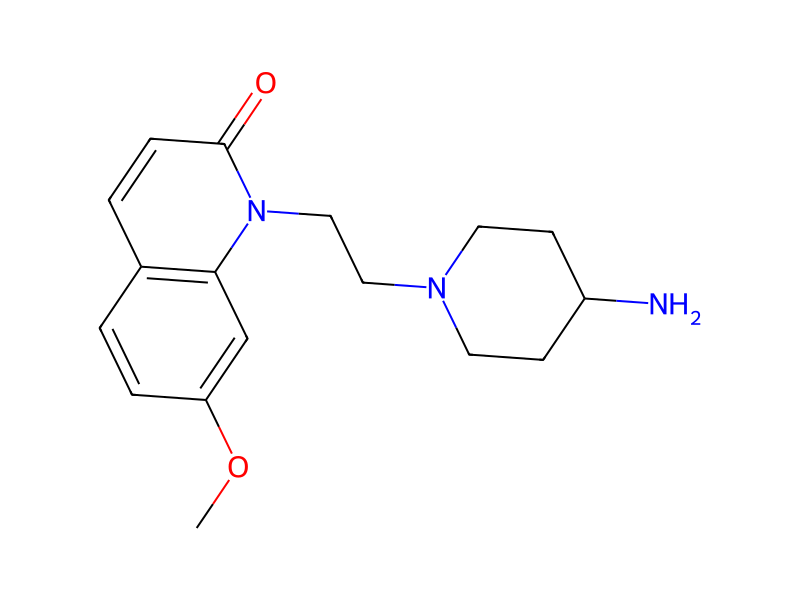
HCID 5049666Sodium triacetoxyborohydrideHCID 218736682,3-Dihydro[1,4]dioxino[2,3-c]pyridine-7-carbaldehydeHCID 593982891-[2-(4-aminopiperidin-1-yl)ethyl]-7-methoxyquinolin-2(1H)-one2×

Product 1

HCID 119833621-(2-{4-[(2,3-Dihydro[1,4]dioxino[2,3-c]pyridin-7-ylmethyl)amino]piperidin-1-yl}ethyl)-7-methoxyquinolin-2(1H)-one

Reagents, catalysts & solvents 1

HCID 21584188
Chloroform methanol
Solvent

Conditions

Temperature
0 °C

Procedure

A solution of 1-[2-(4-aminopiperidin-1-yl)ethyl]-7-methoxyquinolin-2(1H)-one (Intermediate 1, crude, 60 mg, 0.20 mmol) and 2,3-dihydro[1,4]dioxino[2,3-c]pyridine-7-carbaldehyde (WO 2004/058144) (33 mg, 0.20 mmol) in dry chloroform/methanol (5 mL, 1:1) was heated over 3 Å molecular sieves at 70° C. for 3 hours. The reaction mixture was cooled to 0° C., and sodium triacetoxy borohydride (127 mg, 0.6 mmol) was added. The resulting reaction mixture was stirred at room temperature for 30 minutes and then was filtered through a 0.45 μm membrane and concentrated to dryness under reduced pressure. The residue was taken up in dichloromethane (50 mL) and saturated aqueous sodium hydrogen carbonate solution (5 mL). The pH of the aqueous phase was adjusted to a pH of 10 with 1M aqueous sodium hydroxide solution. The aqueous phase was back extracted twice with dichloromethane (2×20 mL) and the combined organic phases were dried over sodium sulfate and concentrated under reduced pressure. Chromatography on silica gel with dichloromethane/methanol (8:1 to 4:1) gave the free base of the title compound as a colorless oil. The free base was taken up in dichloromethane (2 mL), ethanol (7 mL) was added, followed by addition of 1M HCl in ether (0.3 mL). The colorless precipitate was collected by filtration and gave 50 mg (48%) of the bis-hydrochloride salt of the product, mp 243° C.

Workup

  1. customThe resulting reaction mixture
  2. filtrationwas filtered through a 0.45 μm membrane
  3. concentrationconcentrated to dryness under reduced pressure
  4. extractionThe aqueous phase was back extracted twice with dichloromethane (2×20 mL)
  5. dry with materialthe combined organic phases were dried over sodium sulfate
  6. concentrationconcentrated under reduced pressure

Sources & evidence

ORD record
ord-90af062bafae42dea72df5fa27bafacc
Source dataset
uspto-grants-2011_01
DOI
10.6084/m9.figshare.5104873.v1
Patent number
US07875715B2

Reaction notes

On this pageParticipantsConditionsProcedureWorkupSources & evidenceReaction notes