Reaction equation
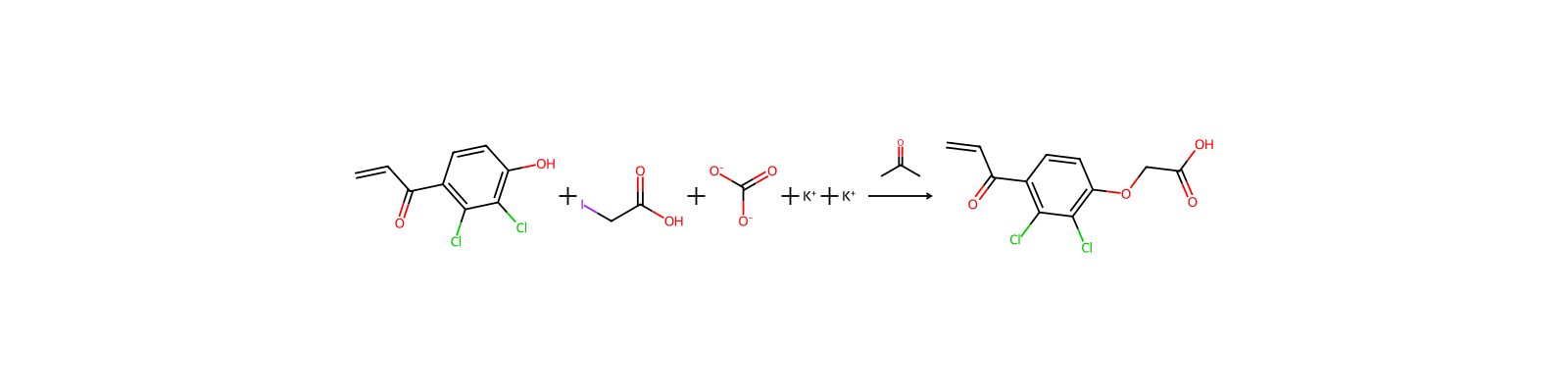
[Cl:1][C:2]1[C:7]([Cl:8])=[C:6]([C:9](=[O:12])[CH:10]=[CH2:11])[CH:5]=[CH:4][C:3]=1[OH:13].I[CH2:15][C:16]([OH:18])=[O:17].C(=O)([O-])[O-].[K+].[K+]>CC(C)=O>[Cl:1][C:2]1[C:7]([Cl:8])=[C:6]([C:9](=[O:12])[CH:10]=[CH2:11])[CH:5]=[CH:4][C:3]=1[O:13][CH2:15][C:16]([OH:18])=[O:17]Participants
5
Reactant 3



Product 1

Reagents, catalysts & solvents 1

Procedure
2,3-Dichloro-4-acryloylphenol (4.85 g, 0.0224 mole), iodoacetic acid (4.5 g, 0.24 mole), potassium carbonate (3.33 g, 0.024 mole) and acetone (200 ml) were united, stirred and refluxed for 20 hours. The reaction mixture was cooled and the solid removed by filtration, dissolved in water (100 ml) and acidified to a pH of 1 with concentrated hydrochloric acid. The material that separated was extracted with chloroform, the organic layer removed, washed with water, dried over MgSO4, filtered and the solvent removed by evaporation in vacuo. The residue was recrystallized from carbon tetrachloride to give 2.2 g of (2,3-dichloro-4-acryloylphenoxy)-acetic acid, m.p. 111°-113° C.
Workup
- temperaturerefluxed for 20 hours
- temperatureThe reaction mixture was cooled
- customthe solid removed by filtration
- dissolutiondissolved in water (100 ml)
- customThe material that separated
- extractionwas extracted with chloroform
- customthe organic layer removed
- washwashed with water
- dry with materialdried over MgSO4
- filtrationfiltered
- customthe solvent removed by evaporation in vacuo
- customThe residue was recrystallized from carbon tetrachloride
Sources & evidence
- ORD record
- ord-e78cce5e0b18492bb04bdc49b63ef128
- Source dataset
- uspto-grants-1987_10
- Patent number
- US04699926
Linked notes
Loading…