Reaction equation

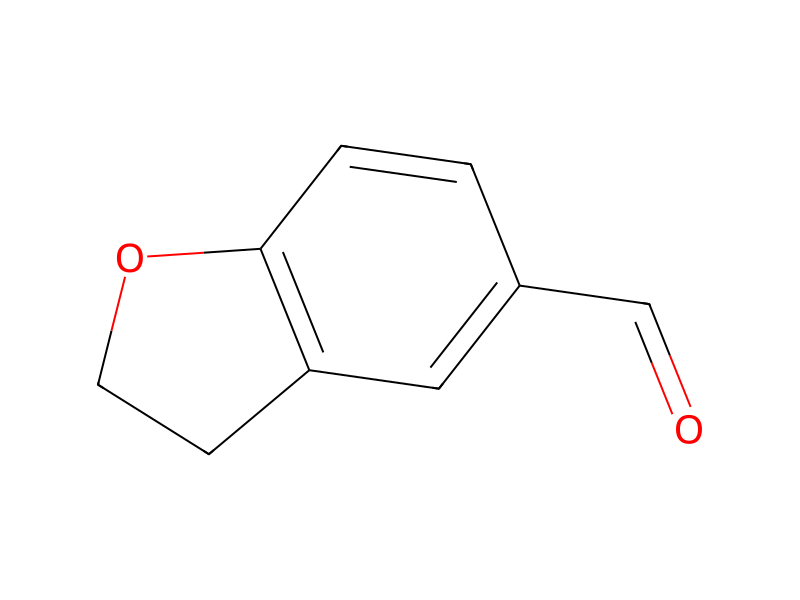
[O:1]1[C:5]2[CH:6]=[CH:7][CH:8]=[CH:9][C:4]=2[CH2:3][CH2:2]1.ClC[CH:12]([O:15]C(CCl)CCl)CCl.C(=O)(O)[O-].[Na+]>C(Cl)Cl.[Ti](Cl)(Cl)(Cl)Cl>[CH:12]([C:8]1[CH:7]=[CH:6][C:5]2[O:1][CH2:2][CH2:3][C:4]=2[CH:9]=1)=[O:15]Participants





Procedure
A solution of 9.4 ml (83.4 mmol) 2,3-dihydrobenzofuran in 250 ml methylene dichloride was cooled under nitrogen to 0° to -5° C. and 18 ml (167 mmole) titanium tetrachloride was added dropwise at 0° C. The resulting brown mixture was stirred 10 minutes and 8.3 ml (91.6 mmole) 1,1-dichloromethylmethyl ether was then added dropwise at 0° C. During this addition the reaction mixture became dark red in color. The mixture was allowed to warm to room temperature, stirred for 2 hours and poured slowly into a 2 liter beaker containing 700 ml saturated aqueous sodium bicarbonate solution The resulting mixture was filtered through diatomaceous earth and the solids washed with methylene dichloride. The separated organic layer was dried (Na2SO4) and the solvent evaporated to afford a residual oil, 10 g, (81%) which appeared homogeneous on silica gel thin-layer chromatography (TLC), eluting with an ethyl acetate/hexane/5% acetic acid, 1:5:5 by volume. Mass spectrum (m/e): 148 (M+), 147, 119.
Workup
- additionDuring this addition the reaction mixture
- stirringstirred for 2 hours
- additionpoured slowly into a 2 liter beaker
- filtrationwas filtered through diatomaceous earth
- washthe solids washed with methylene dichloride
- dry with materialThe separated organic layer was dried (Na2SO4)
- customthe solvent evaporated
- customto afford a residual oil, 10 g, (81%) which
- washeluting with an ethyl acetate/hexane/5% acetic acid, 1:5:5 by volume
Sources & evidence
- ORD record
- ord-f0a401c2f49446cdb78279afe412c8a5
- Source dataset
- uspto-grants-1987_10
- Patent number
- US04703052
Linked notes
Loading…