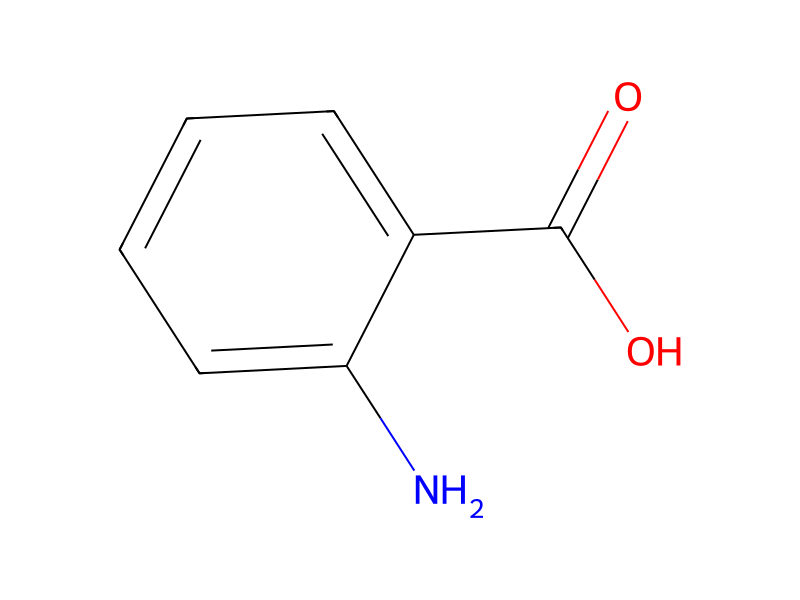
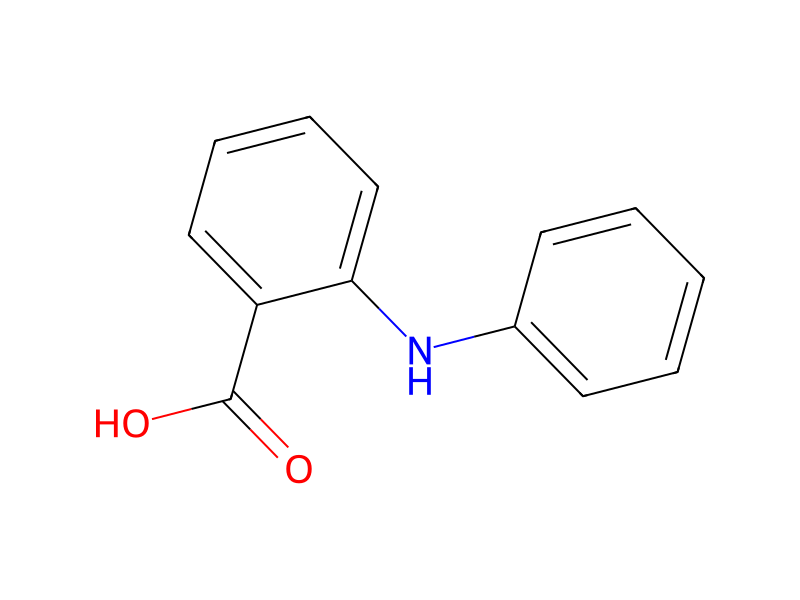
Anthranilic Acid → N-Phenylanthranilic Acid
Reaction equation

Br[C:2]1[CH:3]=[C:4](C)[CH:5]=[CH:6][C:7]=1[N+]([O-])=O.[NH2:12][C:13]1[CH:21]=[CH:20][CH:19]=[CH:18][C:14]=1[C:15]([OH:17])=[O:16]>>[C:2]1([NH:12][C:13]2[C:14](=[CH:18][CH:19]=[CH:20][CH:21]=2)[C:15]([OH:17])=[O:16])[CH:3]=[CH:4][CH:5]=[CH:6][CH:7]=1Participants
3

Procedure
As shown in Scheme 7, coupling of 3-bromo-4-nitrotoluene with 2-amino-benzoic acid via an Ullmann reaction yields an N-phenyl-anthranilic acid. After protection of the acid with 2-amino-2-methyl-1-propanol, oxidation affords the corresponding aldehyde. Addition of vinyl magnesium bromide and deprotection provides the N-phenyl-anthranilic acid containing a latent Michael acceptor. ##STR15##
Sources & evidence
- ORD record
- ord-b14e64830dbb4528bce163796757ab04
- Source dataset
- uspto-grants-1993_11
- Patent number
- US05258296
Reaction notes
Loading…