Triisopropyl borate → Boronic acid, B-(2-(((1,1-dimethylethyl)amino)sulfonyl)phenyl)-
Reaction equation
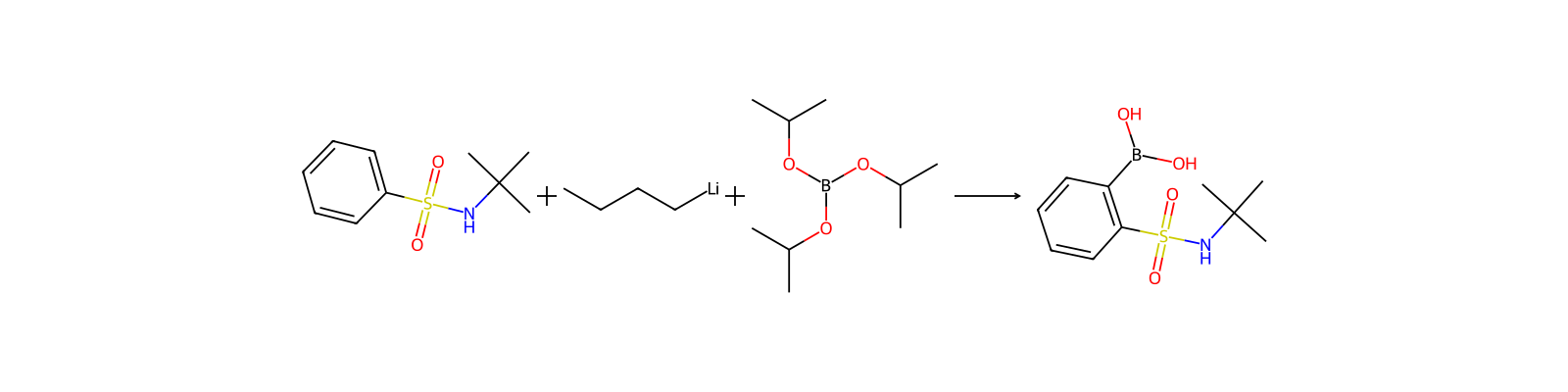
[C:1]([NH:5][S:6]([C:9]1[CH:14]=[CH:13][CH:12]=[CH:11][CH:10]=1)(=[O:8])=[O:7])([CH3:4])([CH3:3])[CH3:2].C([Li])CCC.[B:20](OC(C)C)([O:25]C(C)C)[O:21]C(C)C>>[C:1]([NH:5][S:6]([C:9]1[CH:14]=[CH:13][CH:12]=[CH:11][C:10]=1[B:20]([OH:25])[OH:21])(=[O:8])=[O:7])([CH3:4])([CH3:2])[CH3:3]Participants
4




Procedure
By the method described in Example 10, Step B, N-t-butylbenzenesulfonamide [G. Lombardino, J. Org. Chem., 36, 1843 (1971)] was deprotonated with n-butyllithium, and the resulting dianion was reacted with triisopropyl borate and worked up with acid to give the title compound, which was used directly in the next step without further purification.
Sources & evidence
- ORD record
- ord-45a3114f918c4e9b96cbd287d3a35cb3
- Source dataset
- uspto-grants-1993_11
- Patent number
- US05262412
Reaction notes
Loading…