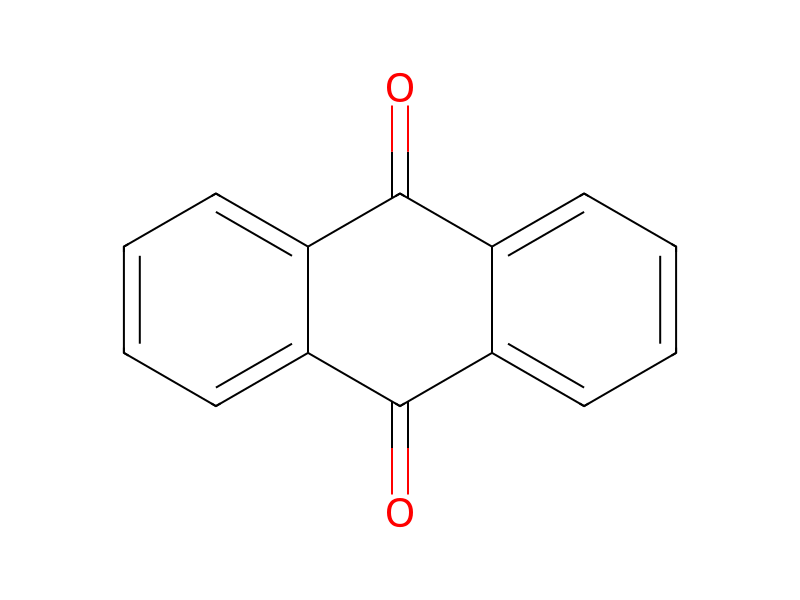
Anthraquinone → Tetrahydroanthraquinone
HRID 258585
Reaction equation

[CH:1]1[C:14]2[C:13](=[O:15])[C:12]3[C:7](=[CH:8][CH:9]=[CH:10][CH:11]=3)[C:6](=[O:16])[C:5]=2[CH:4]=[CH:3][CH:2]=1.C=CC=C>>[CH2:4]1[C:5]2[C:6](=[O:16])[C:7]3[C:12](=[CH:11][CH:10]=[CH:9][CH:8]=3)[C:13](=[O:15])[C:14]=2[CH2:1][CH2:2][CH2:3]1Participants
3


Procedure
The liquid taken off at the sump of the quencher is divided into two partial streams. One partial stream, for example about 0.1 to 10%, preferably about 0.3 to 1.5%, of the total stream, is withdrawn from the system. This partial stream which is withdrawn contains the naphthoquinone and phthalic anhydride, isolated by the process according to the invention, in the form of a solution in naphthalene. This process product can be worked up to give pure naphthoquinone and pure phthalic anhydride but it is preferably further used directly, for example for the preparation of anthraquinone by reacting the process product with butadiene to give tetrahydroanthraquinone and subsequently converting this to anthraquinone. Preferably, the amount of process product which is withdrawn from the process corresponds to the amount of naphthoquinone and phthalic anhydride which is introduced into the quencher with the feed gas.