Reaction equation

[O-:1][C:2]#[N:3].[K+].S1(CCCC1)(=O)=O.Br[CH2:13][CH3:14].[C:15]([CH2:17][CH2:18][N:19]([CH2:26][CH2:27][OH:28])[C:20]1[CH:25]=[CH:24][CH:23]=[CH:22][CH:21]=1)#[N:16]>O>[C:15]([CH2:17][CH2:18][N:19]([CH2:26][CH2:27][O:28][C:2](=[O:1])[NH:3][CH2:13][CH3:14])[C:20]1[CH:25]=[CH:24][CH:23]=[CH:22][CH:21]=1)#[N:16]Participants


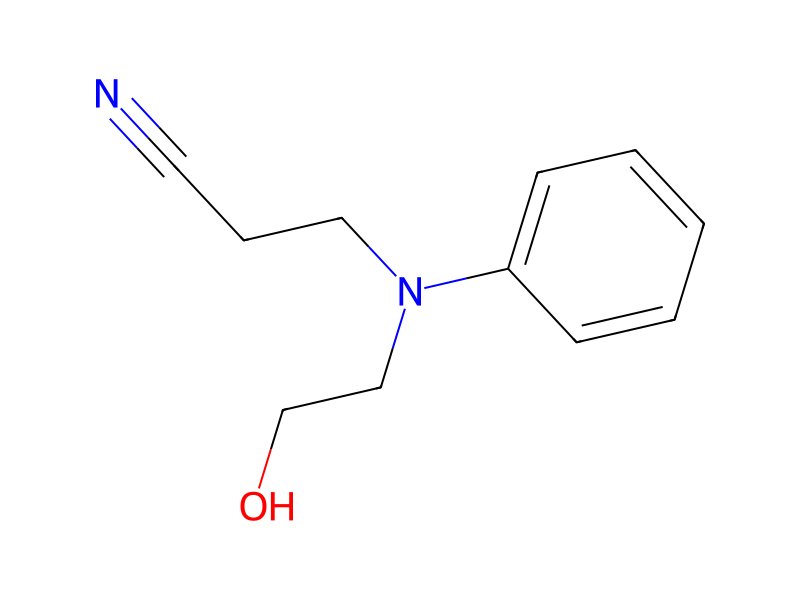



Conditions
- Temperature
- 90 °C
Procedure
Into a 500 ml. three-necked round-bottomed flask equipped with thermometer, stirrer, reflux condenser, and dropping funnel are placed 40 g. (0.493 mole) of potassium cyanate and 250 ml. of sulfolane (tetrahydrothiophene-1,1-dioxide). This mixture is heated with stirring to 90° C. by means of an oil bath. Bromoethane (95 g., 0.8 mole) is then added dropwise to the mixture over a 1.5 hour period. The temperature of the reaction mixture drops to 75° C. during the addition of bromoethane. A solution of 50 g. (0.228 mole, 86.5%) N-(2-cyanoethyl)-N-(2-hydroxyethyl) aniline in 50 ml. of sulfolane is added, and heating of the resulting mixture is continued at 90° C. for three hours. The reaction mixture is cooled to room temperature and then poured into 2 liters of cold water. The mixture is agitated for 0.5 hour, and the two resulting layers separated. TLC of the organic layer in 4:1 benzene:acetone shows only a trace of starting material. The infrared spectrum of the product of the above formula shows absorptions at 3370, 2250, 1915, 1680, and 596 cm-1.
Workup
- customthree-necked round-bottomed flask equipped with thermometer, stirrer
- temperaturereflux condenser
- temperatureThis mixture is heated
- temperatureheating of the resulting mixture
- temperatureThe reaction mixture is cooled to room temperature
- stirringThe mixture is agitated for 0.5 hour
- customthe two resulting layers separated
Sources & evidence
- ORD record
- ord-a0a3b9ed9b4f48ae977754f28469faf6
- Source dataset
- uspto-grants-1979_04
- Patent number
- US04147716
Linked notes
Loading…