HomeMCPWorkbenchSkills
HomeWorkbenchNotificationsMe
llms.txt · MCP GuidePrivacy Policy · Terms of Service · Supportv1.8.3
  1. Home
  2. /Reaction

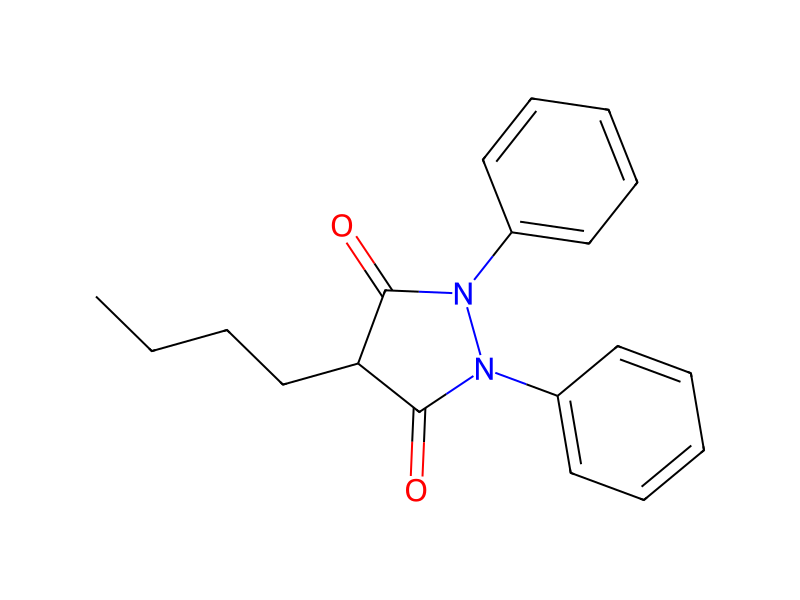
Phenylbutazone → 1,2-Diphenyl-4-butyl-4-pivalyloxymethyl-3,5-pyrazolidinedione

HRID 259178
Print

Reaction equation

HRID 259178 reaction equation
C(=O)([O-])[O-].[K+].[K+].[CH3:7][CH2:8][CH2:9][CH2:10][CH:11]1[C:16](=[O:17])[N:15]([C:18]2[CH:19]=[CH:20][CH:21]=[CH:22][CH:23]=2)[N:14]([C:24]2[CH:25]=[CH:26][CH:27]=[CH:28][CH:29]=2)[C:12]1=[O:13].[C:30]([O:36][CH2:37]Cl)(=[O:35])[C:31]([CH3:34])([CH3:33])[CH3:32]>CC(C)=O>[C:24]1([N:14]2[C:12](=[O:13])[C:11]([CH2:10][CH2:9][CH2:8][CH3:7])([CH2:37][O:36][C:30](=[O:35])[C:31]([CH3:34])([CH3:33])[CH3:32])[C:16](=[O:17])[N:15]2[C:18]2[CH:19]=[CH:20][CH:21]=[CH:22][CH:23]=2)[CH:25]=[CH:26][CH:27]=[CH:28][CH:29]=1
ParticipantsProcedureWorkupSources & evidenceReaction notes

Participants

5

Reactant 3

HCID 4781PhenylbutazoneHCID 11430Potassium CarbonateHCID 87885Chloromethyl pivalate

Product 1

HCID 203916791,2-Diphenyl-4-butyl-4-pivalyloxymethyl-3,5-pyrazolidinedioneYield 5%

Reagents, catalysts & solvents 1

HCID 180AcetoneSolvent

Procedure

Potassium carbonate (2.26 g, 0.016 mole) was suspended in an acetone (125 ml) solution of phenylbutazone and the suspension was refluxed overnight. The next day pivalyloxymethyl chloride (4.99 g, 0.033 mole) was added to the resulting solution and the solution was refluxed overnight. The suspension was cooled and filtered; the residue (2.00 g, 83%) was potassium chloride. The filtrate was concentrated in vacuo and the residue was suspended in ether, then filtered. The residue was washed with ether until the washings did not contain any product by TLC. The residue from the ether suspension was the potassium salt of phenylbutazone (2.25 g, 20%). The ether was then concentrated in vacuo and the residue was absorbed on silica gel and chromatographed on neutral silica gel (CC-7, Mallinckrodt) using petroleum ether bp 30°-60° C. -- ether (1:1) as the eluent to give two fractions. The first fraction (Rf 0.46, silica gel, heptane-ether, 1:1 was crystallized from heptane-petroleum ether bp 30-60° C., 1:1 to give 0.63 g (mp 116°-117° C., 5% yield) of 1,2-diphenyl-4-butyl-4-pivalyloxymethyl-3,5-pyrazolidinedione. nmr (CDCl3) δ 4.40 (S, 2, ##STR10##

Workup

  1. temperaturethe suspension was refluxed overnight
  2. temperaturethe solution was refluxed overnight
  3. temperatureThe suspension was cooled
  4. filtrationfiltered
  5. concentrationThe filtrate was concentrated in vacuo
  6. filtrationfiltered
  7. washThe residue was washed with ether until the washings
  8. concentrationThe ether was then concentrated in vacuo
  9. customthe residue was absorbed on silica gel
  10. customchromatographed on neutral silica gel (CC-7, Mallinckrodt)
  11. customether (1:1) as the eluent to give two fractions
  12. customThe first fraction (Rf 0.46, silica gel, heptane-ether, 1:1 was crystallized from heptane-petroleum ether bp 30-60° C., 1:1

Sources & evidence

ORD record
ord-c6baad51dda245bd954eea8c325ebc72
Source dataset
uspto-grants-1977_07
DOI
10.6084/m9.figshare.5104873.v1
Patent number
US04036845

Reaction notes

On this pageParticipantsProcedureWorkupSources & evidenceReaction notes