Reaction equation
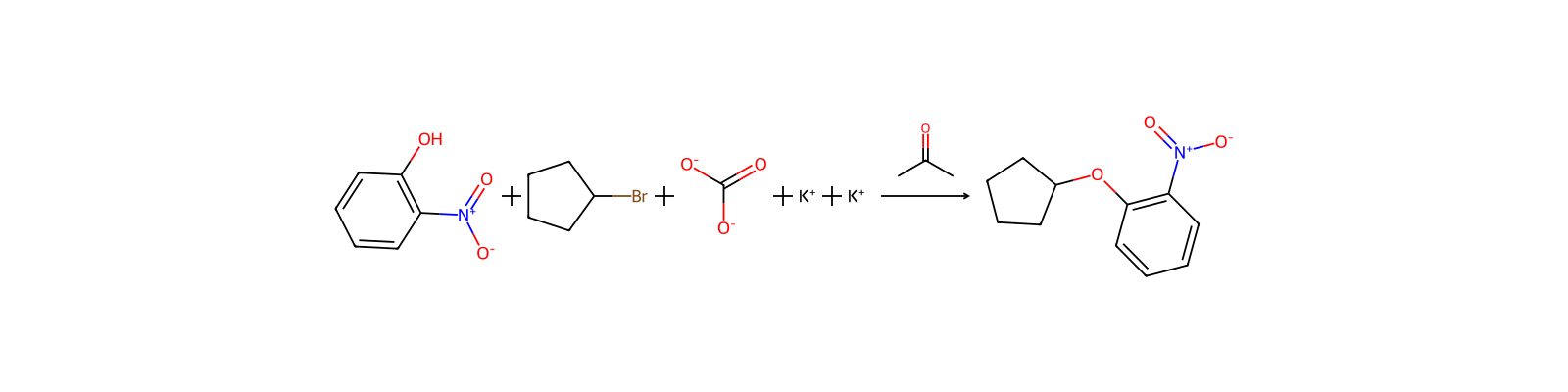
[N+:1]([C:4]1[CH:9]=[CH:8][CH:7]=[CH:6][C:5]=1[OH:10])([O-:3])=[O:2].[CH:11]1(Br)[CH2:15][CH2:14][CH2:13][CH2:12]1.C(=O)([O-])[O-].[K+].[K+]>CC(C)=O>[CH:11]1([O:10][C:5]2[CH:6]=[CH:7][CH:8]=[CH:9][C:4]=2[N+:1]([O-:3])=[O:2])[CH2:15][CH2:14][CH2:13][CH2:12]1Participants
5
Reactant 3



Product 1

Reagents, catalysts & solvents 1

Procedure
2-Nitrophenol (83.5 g, 0.60 mole), cyclopentyl bromide (98.0 g, 0.66 mole), anhydrous potassium carbonate (82.9 g, 0.60 mole) and dry acetone (600 cc) were refluxed for 72 hrs., and filtered to remove the potassium bromide. The residue was washed with acetone and the solvent was removed by rotary evaporation. The residue was partitioned between 200 cc of dichloromethane and water. The dichloromethane layer was washed with 200 cc of 10% potassium hydroxide, separated and the solvent was removed by rotary evaporation. The crude product was fractionally distilled at 144°-146° C. at 1.0 mm. Hg to yield 58.2 g of product (46.8%).
Workup
- filtration, and filtered
- customto remove the potassium bromide
- washThe residue was washed with acetone
- customthe solvent was removed by rotary evaporation
- customThe residue was partitioned between 200 cc of dichloromethane and water
- washThe dichloromethane layer was washed with 200 cc of 10% potassium hydroxide
- customseparated
- customthe solvent was removed by rotary evaporation
- distillationThe crude product was fractionally distilled at 144°-146° C. at 1.0 mm. Hg
Sources & evidence
- ORD record
- ord-9cc3f965c1b640e1b7d43fc85411ead5
- Source dataset
- uspto-grants-1979_05
- Patent number
- US04153446
Linked notes
Loading…