Reaction equation

[Br:1][C:2]1[CH:3]=[C:4]([CH:8]=[C:9]([I:11])[CH:10]=1)[C:5]([OH:7])=[O:6].Cl.CN(C)CCCC(N=C=N)C.[C:24](O)([CH3:27])([CH3:26])[CH3:25]>CN(C)C1C=CN=CC=1.ClCCl>[Br:1][C:2]1[CH:3]=[C:4]([CH:8]=[C:9]([I:11])[CH:10]=1)[C:5]([O:7][C:24]([CH3:27])([CH3:26])[CH3:25])=[O:6]Participants
6
Reactant 3

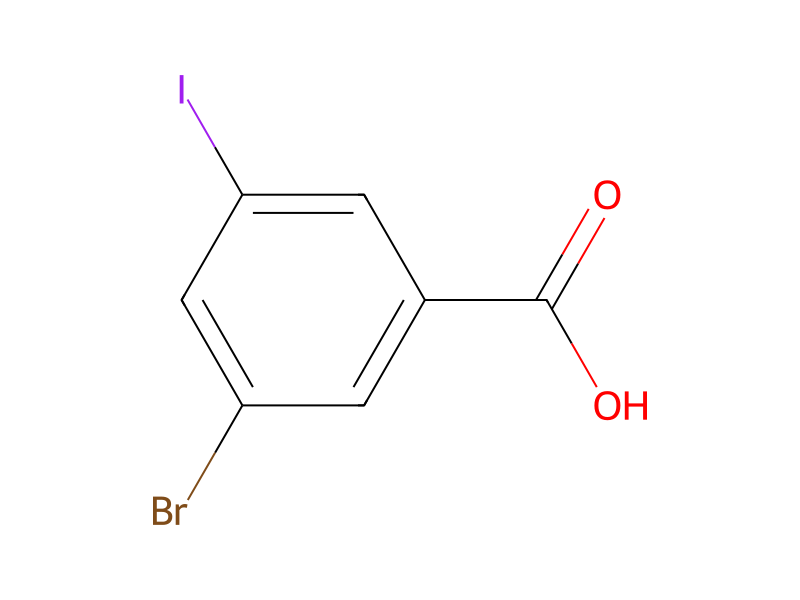

Product 1

Reagents, catalysts & solvents 2


Procedure
A mixture of 3-bromo-5-iodobenzoic acid (50 g, 153 mmol), 1-(3-dimethylaminopropyl)-ethylcarbodiimide hydrochloride (30.8 g, 153 mmol), 4-dimethylaminopyridine (18.6 g, 153 mmol) and t-butanol (69.4 g, 90 ml, 153 mmol) in dichloromethane (500 ml) was stirred at room temperature overnight. The reaction mixture was washed with 2MHCl and saturated NaHCO3. The organic phase was dried and evaporated to give the title compound as a light brown solid. (48 g; 85%).
Workup
- washThe reaction mixture was washed with 2MHCl and saturated NaHCO3
- customThe organic phase was dried
- customevaporated
Sources & evidence
- ORD record
- ord-9d41c9fb650b4654bde723322a0a2f97
- Source dataset
- uspto-grants-2008_11
- Patent number
- US07446222B2
Linked notes
Loading…