Reaction equation

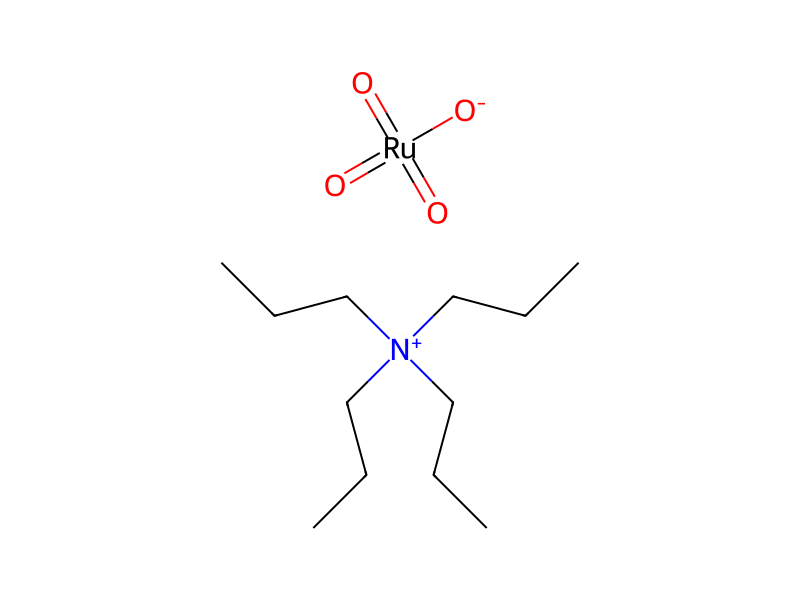
[CH2:1]([N:4]1[CH2:15][CH:14]2[CH2:16][CH:6]([CH:7]([OH:19])[C:8]3[C:13]2=[CH:12][CH:11]=[CH:10][C:9]=3[CH2:17][OH:18])[CH2:5]1)[CH:2]=[CH2:3].ClCCl.O.C[N+]1([O-])CCOCC1>CCOC(C)=O.[Ru]([O-])(=O)(=O)=O.C([N+](CCC)(CCC)CCC)CC>[CH2:1]([N:4]1[CH2:15][CH:14]2[CH2:16][CH:6]([C:7](=[O:19])[C:8]3[C:13]2=[CH:12][CH:11]=[CH:10][C:9]=3[CH:17]=[O:18])[CH2:5]1)[CH:2]=[CH2:3]Participants
Reactant 3



Product 1

Reagents, catalysts & solvents 2

Procedure
11-Allyl-6-hydroxymethyl-11-aza-tricyclo[7.3.1.02,7]trideca-2,4,6-trien-8-ol (93 mg, 0.36 mmol) was dissolved dichloromethane (8 mL) and treated with N-methylmorpholine N-oxide monohydrate (73 mg, 0.54 mmol), powdered 4 Å molecular sieves (180 mg) and TPAP (TETRAPROPYLAMMONIUM PERRUTHENATE) 6.0 mg, 0.02 mmol). After 18 h, the mixture was stripped, dissolved in EtOAc and filtered through a silica gel pad. The organic layer was washed with H2O (2×30 mL), saturated aqueous NaCl solution (30 mL), dried over MgSO4, filtered and concentrated to give an oil (75 mg, 81%). (TLC 30% EtOAc/hexanes Rf 0.70); 1H NMR (400 MHz, CDCl3) δ 10.62 (s, 1H), 7.62 (dd, J=7.9, 1.4 Hz, 1H), 7.54 (dd, J=7.9, 7.3 Hz, 1H), 7.43 (d, J=7.3 Hz, 1H), 5.46 (m, 1H), 4.93 (m, 2H), 3.19 (m, 2H), 2.82 (m, 3H), 2.73 (br s, 1H), 2.48 (dd, J=10.9, 2.4 Hz, 1H), 2.35 (m, 2H), 1.96 (ddd, J=12.8, 5.4, 2.7 Hz, 1H); 13C NMR (CDCl3, 100 MHz, free base) δ 202.1, 194.5, 148.3, 138.0, 134.6, 134.0, 132.9, 131.6, 126.2, 117.3, 60.8, 57.8, 57.2, 44.1, 36.6, 32.0.
Workup
- filtrationfiltered through a silica gel pad
- washThe organic layer was washed with H2O (2×30 mL), saturated aqueous NaCl solution (30 mL)
- dry with materialdried over MgSO4
- filtrationfiltered
- concentrationconcentrated
Sources & evidence
- ORD record
- ord-3372fdd906794f6d87ca45b5ddf90970
- Source dataset
- uspto-grants-2008_11
- Patent number
- US07456177B2
Linked notes
Loading…