Reaction equation

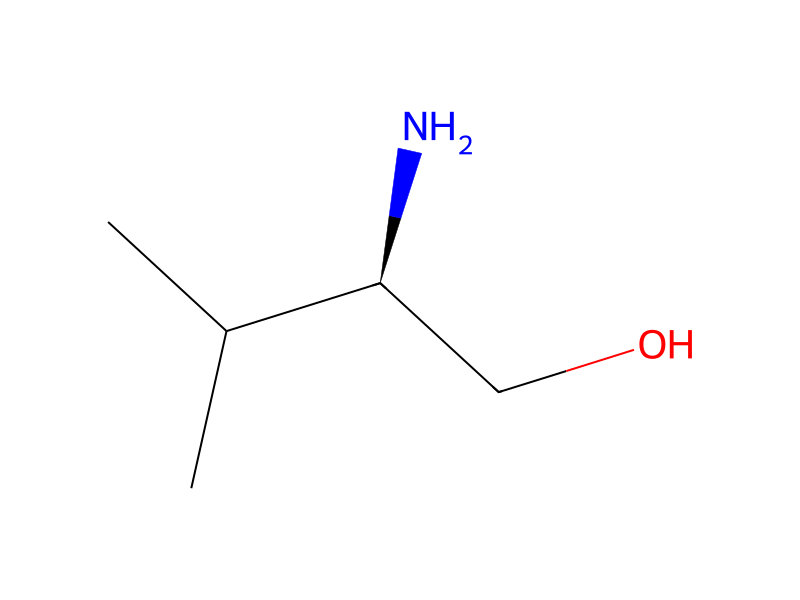
[Cl:1][C:2]1[N:7]=[C:6](Cl)[C:5]([CH2:9][CH3:10])=[CH:4][N:3]=1.C(N(CC)CC)C.[NH2:18][C@H:19]([CH:22]([CH3:24])[CH3:23])[CH2:20][OH:21]>C(#N)C>[Cl:1][C:2]1[N:7]=[C:6]([NH:18][C@H:19]([CH:22]([CH3:24])[CH3:23])[CH2:20][OH:21])[C:5]([CH2:9][CH3:10])=[CH:4][N:3]=1Participants
5
Reactant 3


Product 1

Reagents, catalysts & solvents 1

Procedure
A solution of 882 mg (5.0 mmol) of 2,4-Dichloro-5-ethyl-pyrimidine and 0.75 ml (5.5 mmol) triethylamine in 5 ml of acetonitrile is mixed with 672 mg (6.5 mmol) of (R)-2-Amino-3-methyl-butan-1-ol. The batch is stirred at room temperature for 16 hours and is finally concentrated by evaporation. The remaining residue is purified by chromatography (DCM/EtOH 90:10). 742 mg of the product is obtained that still contains considerable amounts of (R)-2-Amino-3-methyl-butan-1-ol. The material is used without further purifications.
Workup
- concentrationis finally concentrated by evaporation
- customThe remaining residue is purified by chromatography (DCM/EtOH 90:10)
Sources & evidence
- ORD record
- ord-96657b3df174497b88da192d1bcc721a
- Source dataset
- uspto-grants-2008_11
- Patent number
- US07456191B2
Linked notes
Loading…