5-[4-Methylsulfanyl-3-(morpholine-4-sulfonyl)-benzoylamino]-2-(2-{[4-methylsulfanyl-3-(morpholine-4-sulfonyl)-benzoylamino]-phenyl}-vinyl)-benzenesulfonic Acid, 2,2-Dimethylpropyl Ester → 5-[4-Methylsulfanyl-3-(morpholine-4-sulfonyl)-benzoylamino]-2-(2-{[4-methylsulfanyl-3-(morpholine-4-sulfonyl)-benzoylamino]-phenyl}-vinyl)-benzenesulfonic Acid
Reaction equation
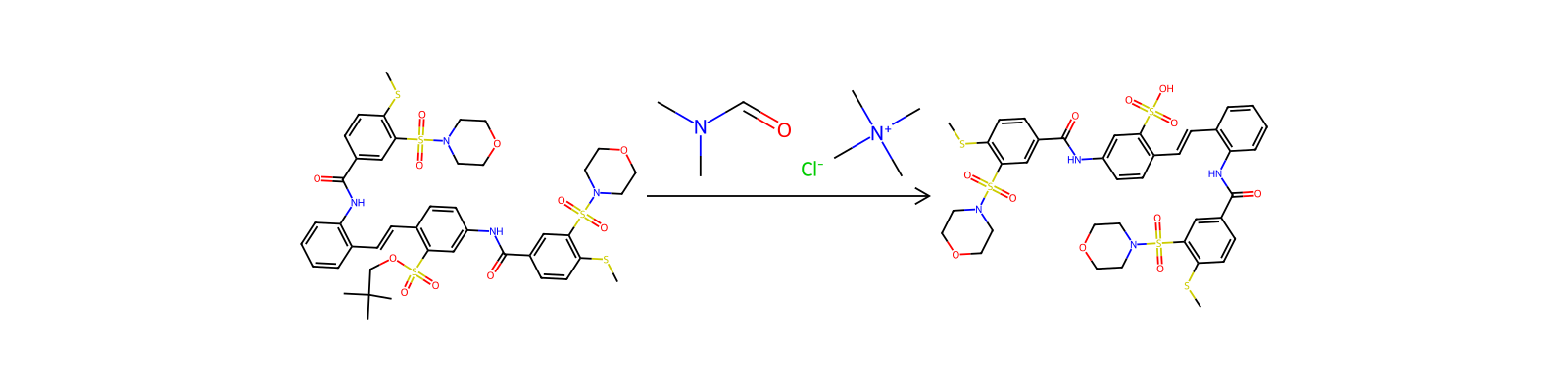
[CH3:1][S:2][C:3]1[CH:54]=[CH:53][C:6]([C:7]([NH:9][C:10]2[CH:11]=[CH:12][C:13]([CH:25]=[CH:26][C:27]3[CH:32]=[CH:31][CH:30]=[CH:29][C:28]=3[NH:33][C:34](=[O:52])[C:35]3[CH:40]=[CH:39][C:38]([S:41][CH3:42])=[C:37]([S:43]([N:46]4[CH2:51][CH2:50][O:49][CH2:48][CH2:47]4)(=[O:45])=[O:44])[CH:36]=3)=[C:14]([S:16]([O:19]CC(C)(C)C)(=[O:18])=[O:17])[CH:15]=2)=[O:8])=[CH:5][C:4]=1[S:55]([N:58]1[CH2:63][CH2:62][O:61][CH2:60][CH2:59]1)(=[O:57])=[O:56]>CN(C)C=O.[Cl-].C[N+](C)(C)C>[CH3:1][S:2][C:3]1[CH:54]=[CH:53][C:6]([C:7]([NH:9][C:10]2[CH:11]=[CH:12][C:13]([CH:25]=[CH:26][C:27]3[CH:32]=[CH:31][CH:30]=[CH:29][C:28]=3[NH:33][C:34](=[O:52])[C:35]3[CH:40]=[CH:39][C:38]([S:41][CH3:42])=[C:37]([S:43]([N:46]4[CH2:51][CH2:50][O:49][CH2:48][CH2:47]4)(=[O:45])=[O:44])[CH:36]=3)=[C:14]([S:16]([OH:19])(=[O:18])=[O:17])[CH:15]=2)=[O:8])=[CH:5][C:4]=1[S:55]([N:58]1[CH2:63][CH2:62][O:61][CH2:60][CH2:59]1)(=[O:57])=[O:56]Participants
Reactant 1
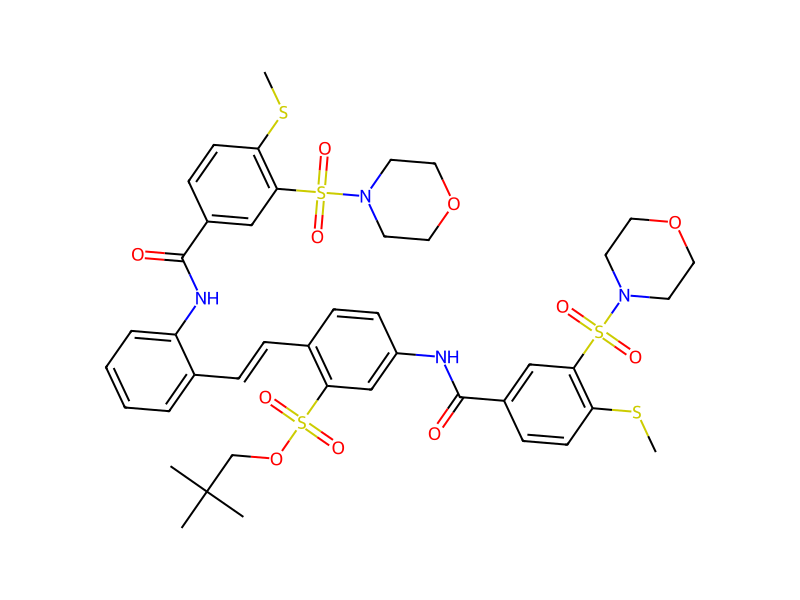
Product 1

Reagents, catalysts & solvents 2

Conditions
- Temperature
- 100 °C
Procedure
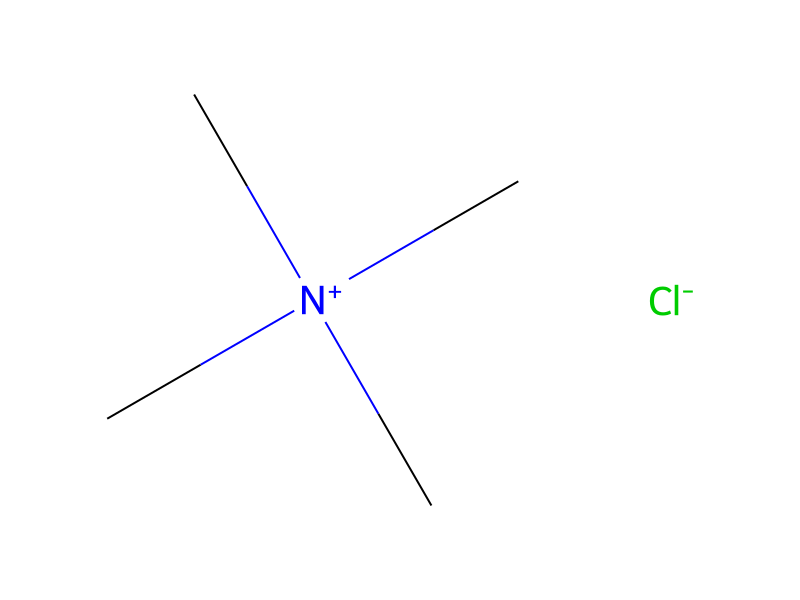
To a solution of 5-[4-methylsulfanyl-3-(morpholine-4-sulfonyl)-benzoylamino]-2-(2-{[4-methylsulfanyl-3-(morpholine-4-sulfonyl)-benzoylamino]-phenyl}-vinyl)-benzenesulfonic acid, 2,2-dimethylpropyl ester (Example 58, 0.30 g, 0.31 mimol) in 10 mL of anhydrous dimethylformamide was added tetramethylammonium chloride (0.069 g, 0.62 mmol) and the solution purged with nitrogen. The mixture was then heated to 100° C. and its progress followed by analytical reverse phase HPLC. After two days no starting material remained and the reaction was cooled to room temperature. After filtering to remove excess tetramethylammonium chloride the mixture was concentrated to dryness and the purified using reverse phase HPLC (70% THF/water) as the eluant. Freeze drying overnight afforded 120 mg of the title compound as a yellow solid.(43%): 1HNMR (DMSO-d6) δ10.59 (s, 1H), 10.54 (s, 1H), 8.41 (dd, J=7 Hz, 2 Hz, 2H), 8.27 (m, 2H), 8.19 (d, J=16 Hz, 1H), 8.13 (d, J=2 Hz, 1H), 7.99 (dd, J=9 Hz, 2 Hz, 1H), 7.82 (d, J=8.5 Hz, 2), 7.79 (d J=7 Hz, 1H), 7.65 (dd, J=9 Hz, 2 Hz, 2H), 7.51 (d, J=8.5 Hz, 2H), 7.08 (d, J=16 Hz, 1H), 3.61 (m, 8H), 3.15 (m, 8H), 2.60 (s, 6H); MS (ES-NEG): [M−H]− 887; Anal. Calc. for C38H40N4O11S5-2.2H2O: C, 49.14; H, 4.82; N, 6.03. Found: C, 49.17; H, 5.07; N, 5.04. Analytical reverse phase HPLC shows compound is >90% pure.
Workup
- customthe solution purged with nitrogen
- temperaturethe reaction was cooled to room temperature
- filtrationAfter filtering
- customto remove excess tetramethylammonium chloride the mixture
- concentrationwas concentrated to dryness
- customFreeze drying overnight
Sources & evidence
- ORD record
- ord-07b3a34f2ddf4af5a60fc5b966b21149
- Source dataset
- uspto-grants-2002_03
- Patent number
- US06355633B1
Linked notes
Loading…