Reaction equation
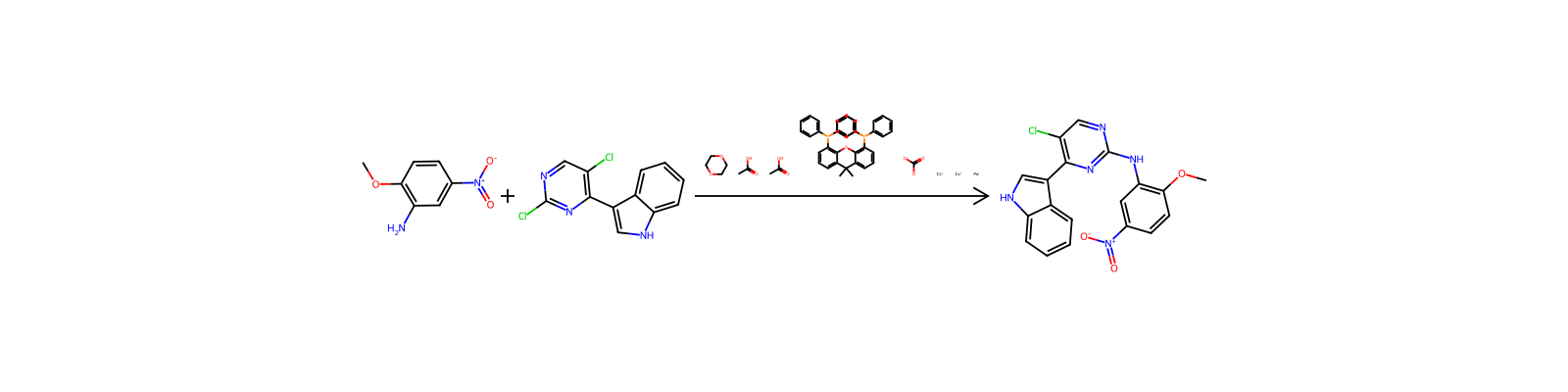
COc1ccc([N+](=O)[O-])cc1N.Clc1ncc(Cl)c(-c2c[nH]c3ccccc23)n1>C1COCCO1.CC(=O)O.CC(=O)O.CC1(C)c2cccc(P(c3ccccc3)c3ccccc3)c2Oc2c(P(c3ccccc3)c3ccccc3)cccc21.O=C([O-])[O-].[Cs+].[Cs+].[Pd]>COc1ccc([N+](=O)[O-])cc1Nc1ncc(Cl)c(-c2c[nH]c3ccccc23)n1Participants
7
Reactant 2


Product 1

Reagents, catalysts & solvents 4



Conditions
- Temperature
- 80 °C
Procedure
To a stirred solution of 3-(2,5-dichloropyrimidin-4-yl)-1H-indole (100 mg, 0.38 mmol) in dioxane (10 mL) was added 2-methoxy-5-nitroaniline (63.7 mg, 0.38 mmol), cesium carbonate (247 mg, 0.76 mmol) and (9,9-dimethyl-9H-xanthene-4,5-diyl)bis(diphenylphosphine) (26.3 mg, 0.05 mmol). The resulting suspension was purged with nitrogen for 5 minutes. diacetoxypalladium (5.10 mg, 0.02 mmol) was added and the mixture was purged with nitrogen for a further 5 minutes, and then heated at 80 °C overnight. UPLC shows di-Cl SM almost completely consumed but no evidence of desired product. Reaction stopped
Sources & evidence
- ORD record
- ord-95b63e9e9ac540bc8fc7f0ffbc5bc6a7
- Source dataset
- 750 AstraZeneca ELN dataset
- Original link
- View source
Linked notes
Loading…