Reaction equation
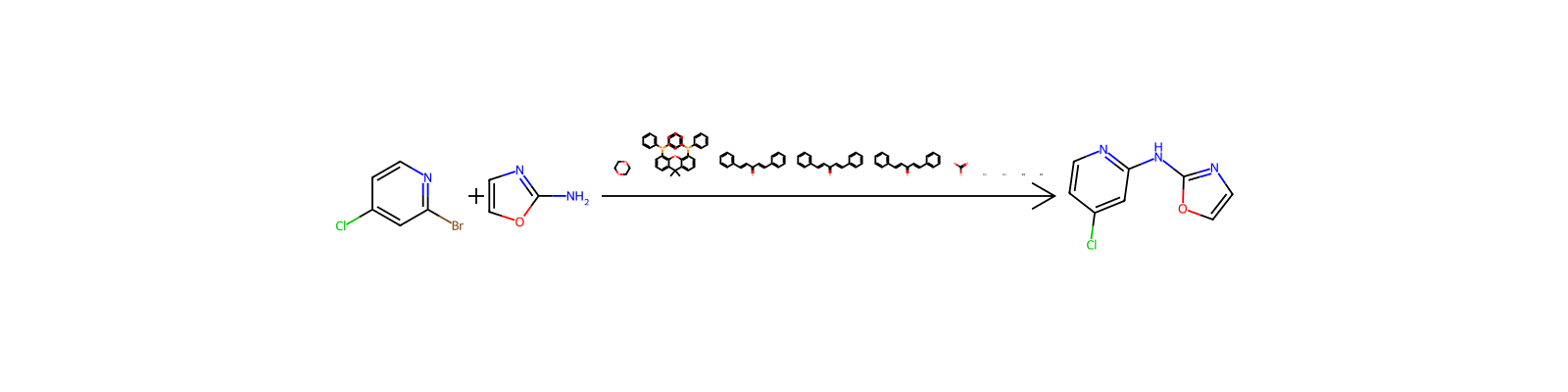
Clc1ccnc(Br)c1.Nc1ncco1>C1COCCO1.CC1(C)c2cccc(P(c3ccccc3)c3ccccc3)c2Oc2c(P(c3ccccc3)c3ccccc3)cccc21.O=C(/C=C/c1ccccc1)/C=C/c1ccccc1.O=C(/C=C/c1ccccc1)/C=C/c1ccccc1.O=C(/C=C/c1ccccc1)/C=C/c1ccccc1.O=C([O-])[O-].[Cs+].[Cs+].[Pd].[Pd]>Clc1ccnc(Nc2ncco2)c1Participants
Reactant 2


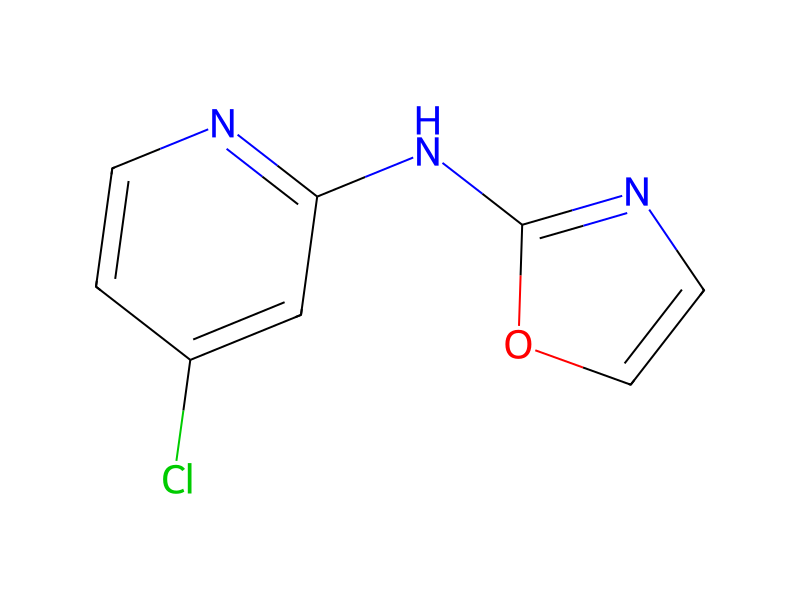
Product 1
Reagents, catalysts & solvents 4




Conditions
- Temperature
- 140 °C
Procedure
Objective: To find out if the 2-bromopyridine is a more efficient coupling partner than the chloro analogue. Pd2(dba)3 (22.89 mg, 0.025 mmol), 9,9-dimethyl-4,5-bis(diphenylphosphino)xanthene (43.4 mg, 0.075 mmol), 2-bromo-4-chloropyridine (192 mg, 1.00 mmol), cesium carbonate (652 mg, 2.00 mmol) and oxazol-2-amine (84 mg, 1.00 mmol) were added to an oven dried microwave vial, the vial was capped and placed under an inert atmosphere, dioxane (4 mL) was added and the resulting mixture was heated at 140 °C for 1 h by microwave irradiation under a nitrogen atmosphere. The crude product was purified by flash silica chromatography, elution gradient 0 to 30% EtOAc in heptane. Pure fractions were evaporated to dryness to afford N-(4-chloropyridin-2-yl)oxazol-2-amine (15.00 mg, 7.67 %) as a white solid. Conclusion: A slightly improved yield of the desired product was formed with respect to the 2,4-dichloropyridine substrate, however the difference could not be taken to be significant.
Sources & evidence
- ORD record
- ord-25a2d29381d0432e90a88d041ce4da72
- Source dataset
- 750 AstraZeneca ELN dataset
- Original link
- View source
Linked notes
Loading…