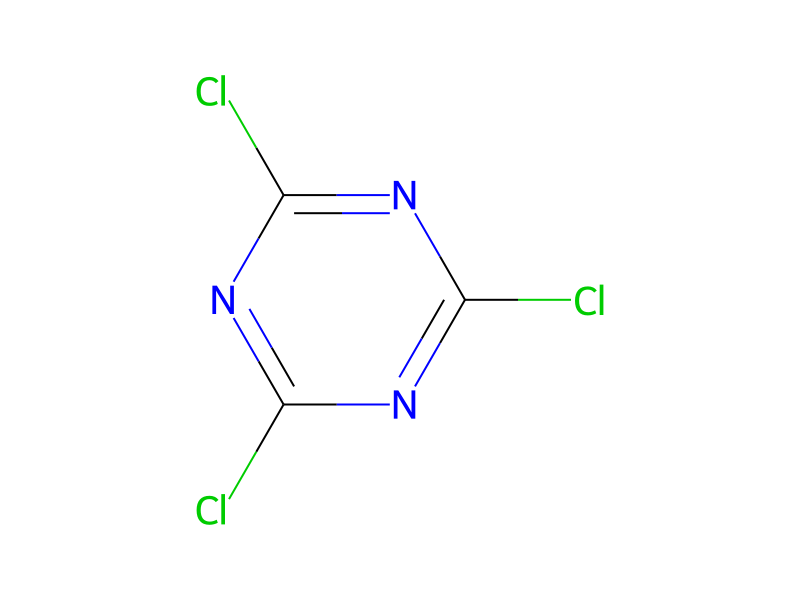
Cyanuric chloride → 2,4-Dichloro-6-phenyl-1,3,5-triazine
HRID 325751
Reaction equation

[N:1]1[C:8]([Cl:9])=[N:7][C:5]([Cl:6])=[N:4][C:2]=1Cl.[C:10]1([Mg]Br)[CH:15]=[CH:14][CH:13]=[CH:12][CH:11]=1>>[C:10]1([C:2]2[N:4]=[C:5]([Cl:6])[N:7]=[C:8]([Cl:9])[N:1]=2)[CH:15]=[CH:14][CH:13]=[CH:12][CH:11]=1Participants
3


Procedure
One mole of cyanuric chloride was treated with one mole of phenylmagnesium bromide in Step I to form 6-phenyl-2,4-dichloro-s-triazine. This reaction is described in detail in a paper by Hirt, et al., Helvetica Chimica Acta 33, pages 1365-9 (1950). In Step II, the product of the reaction of Step I (0.025 mole) was dissolved in chloroform (35 ml) and stirred in an oil bath at 50° C. To this solution was added dropwise with stirring a solution of sodium hydroxide (0.05 mole), 3-ethynylphenol (0.05 mole), and water (25 ml) during one hour. The reaction was continued overnight and yielded an organic phase which was subsequently separated and dried over sodium sulfate. Removal of solvent under reduced pressure gave a solid product, 6-phenyl-2,4-bis(3-ethynylphenoxy)-s-triazine, mp 139°-144° C., which thermally cured at 260° C. to a heat stable polymer.