Reaction equation

S(Cl)(Cl)=O.[CH3:5][C:6]1[O:7][CH2:8][CH2:9][S:10][C:11]=1[C:12]([OH:14])=O.[NH2:15][C:16]1[CH:17]=[CH:18][C:19]([Cl:26])=[C:20]([CH:25]=1)[C:21]([O:23][CH3:24])=[O:22].C(N(CC)CC)C>C(Cl)Cl>[Cl:26][C:19]1[CH:18]=[CH:17][C:16]([NH:15][C:12]([C:11]2[S:10][CH2:9][CH2:8][O:7][C:6]=2[CH3:5])=[O:14])=[CH:25][C:20]=1[C:21]([O:23][CH3:24])=[O:22]Participants
Reactant 4



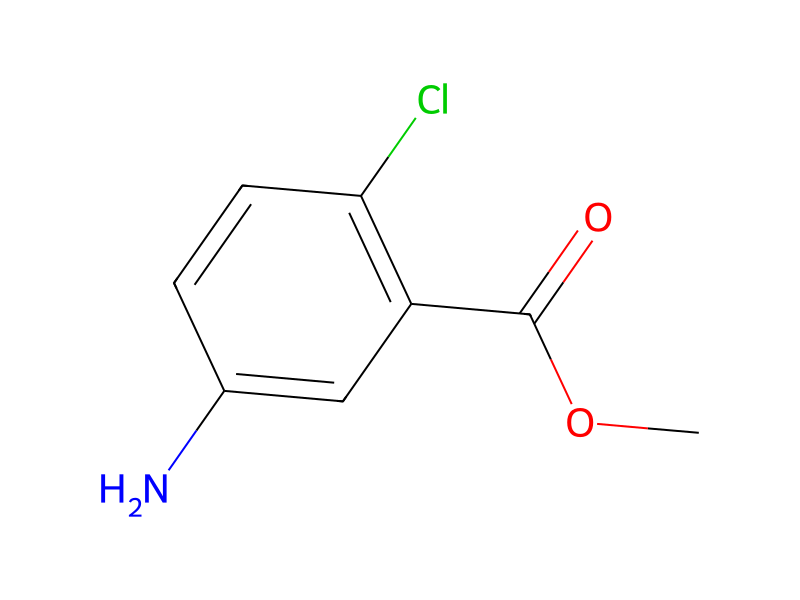
Product 1

Reagents, catalysts & solvents 1

Procedure
Thionyl chloride (4.1 g, 0.034 mole) was added to a stirred mixture of 5,6-dihydro-2-methyl-1,4-oxathiin-3-carboxylic acid (4.3 g, 0.027 mole) and methylene chloride (35 ml). The mixture was warmed to a gentle reflux for about 3.5 hours, left stirring overnight at room temperature, and then evaporated under reduced pressure. The solid residue, crude 5,6-dihydro-2-methyl-1,4-oxathiin-3-carbonyl chloride, was dissolved in methylene chloride (50 ml) and the solution treated dropwise at 5°-10° C. over 2 hours with a solution of methyl 5-amino-2-chlorobenzoate (5.1 g, 0.027 mole) and triethylamine (3.1 g, 0.031 mole) in methylene chloride (35 ml). The reaction mixture was stirred at room temperature for a further 3 hours and worked up by washing in sequence with water (50 ml), dilute hydrochloric acid (3.5%, 50 ml), water (50 ml), dilute sodium hydroxide (2%, 25 ml) and water (50 ml). The methylene chloride was then evaporated to leave an oil (8.2 g), which slowly solidified. Recrystallization from methanol (75 ml) gave a beige solid, m.p. 115°-117° C. (5.5 g, 62.5% yield).
Workup
- temperatureThe mixture was warmed to
- temperaturea gentle reflux for about 3.5 hours
- waitleft
- customevaporated under reduced pressure
- dissolutionThe solid residue, crude 5,6-dihydro-2-methyl-1,4-oxathiin-3-carbonyl chloride, was dissolved in methylene chloride (50 ml)
- stirringThe reaction mixture was stirred at room temperature for a further 3 hours
- washby washing in sequence with water (50 ml), dilute hydrochloric acid (3.5%, 50 ml), water (50 ml), dilute sodium hydroxide (2%, 25 ml) and water (50 ml)
- customThe methylene chloride was then evaporated
Sources & evidence
- ORD record
- ord-e8dabe3b24a44ebd97e0ab3560ef570b
- Source dataset
- uspto-grants-1993_12
- Patent number
- US05268389
Linked notes
Loading…