Benzene → p-Divinylbenzene
HRID 327755
Reaction equation

C1C=CC=CC=1.C([Li])CCC.[CH:12]([C:14]1[CH:19]=[CH:18][C:17]([CH:20]=[CH2:21])=[CH:16][CH:15]=1)=[CH2:13].C1C=CC=CC=1>CCCCCC>[CH:12]([C:14]1[CH:19]=[CH:18][C:17]([CH:20]=[CH2:21])=[CH:16][CH:15]=1)=[CH2:13]Participants
5
Reactant 3

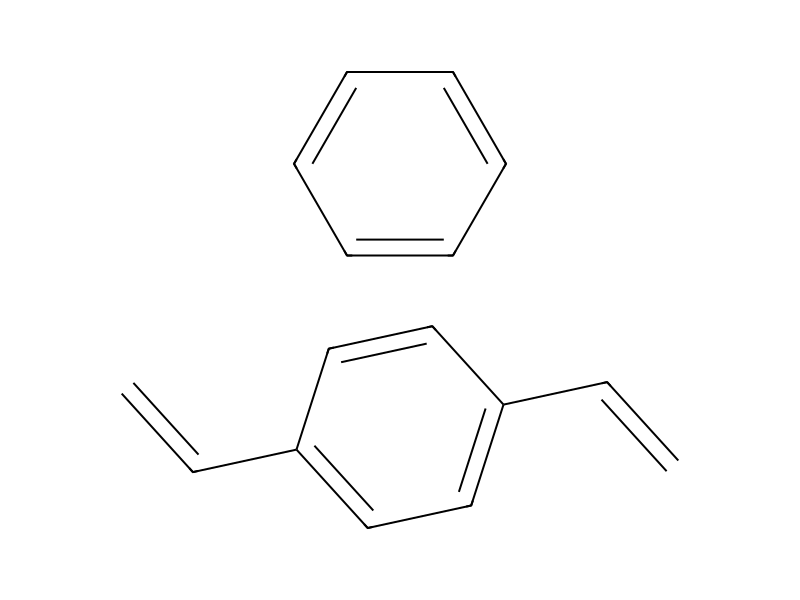

Product 1

Reagents, catalysts & solvents 1

Procedure
Simultaneously, the p-divinylbenzene is distilled from dibutylmagnesium into a clean, flamed and purged valved burette and then diluted by vacuum distillation of 2 times its volume of dry benzene from the stock benzene with n-butyllithium. Next, a clean, flamed and purged, 3-neck, 300 mL reactor flask is fitted with a magnetic stirrer and rubber septum separated from the flask by an in-line, straight-through- bore teflon valve. The burette containing the p-divinylbenzene and benzene is padded with dry argon from the vacuum/argon manifold, the valve is closed and the burette is transferred to the 300 mL reactor flask which is subsequently evacuated and filled with argon several times. Then, about 100 mL benzene is distilled into the reactor flask from the stock benzene/n-butyllithium solution. To the dry benzene in the reactor flask, 0.5 mmoles (0.5 mL of 1.0M solution) of n-butyllithium in hexane is added via gas-tight syringe through the rubber septum and straight-bore valve. After stirring, the reactor flask is cooled to -400° C. and 0.32 mL of the p-divinylbenzene/benzene solution is added dropwise from the burette to give a ratio of p-divinylbenzene to Li+ of 1.5 which produces the micro-particle with the living lithium carbanion initiation sites as indicated by the red-orange color.