Reaction equation
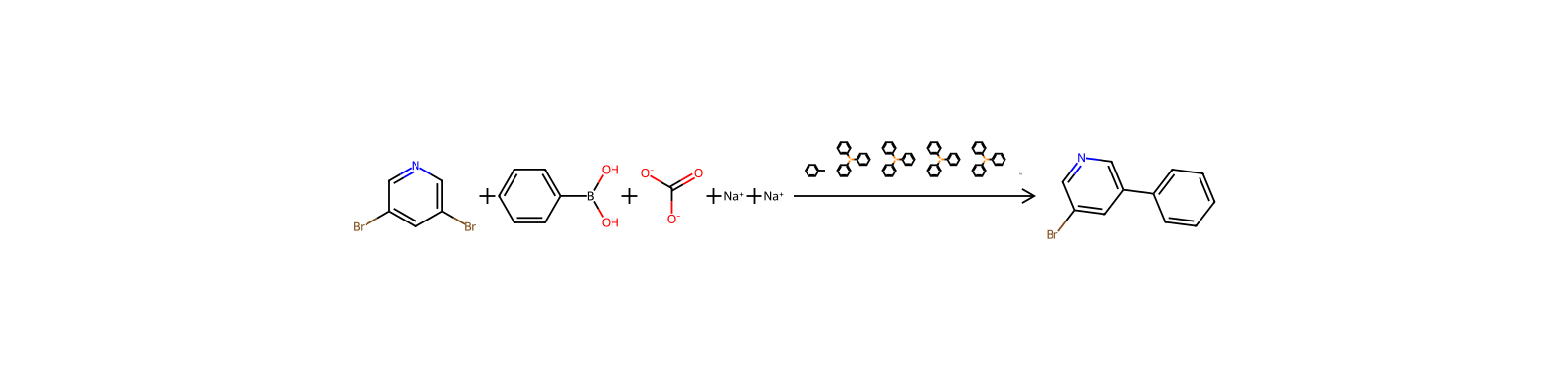
Br[C:2]1[CH:3]=[N:4][CH:5]=[C:6]([Br:8])[CH:7]=1.[C:9]1(B(O)O)[CH:14]=[CH:13][CH:12]=[CH:11][CH:10]=1.C(=O)([O-])[O-].[Na+].[Na+]>C1(C)C=CC=CC=1.C1(P(C2C=CC=CC=2)C2C=CC=CC=2)C=CC=CC=1.C1(P(C2C=CC=CC=2)C2C=CC=CC=2)C=CC=CC=1.C1(P(C2C=CC=CC=2)C2C=CC=CC=2)C=CC=CC=1.C1(P(C2C=CC=CC=2)C2C=CC=CC=2)C=CC=CC=1.[Pd]>[Br:8][C:6]1[CH:5]=[N:4][CH:3]=[C:2]([C:9]2[CH:14]=[CH:13][CH:12]=[CH:11][CH:10]=2)[CH:7]=1Participants
6
Reactant 3



Product 1

Reagents, catalysts & solvents 2


Procedure
Portions of 3,5-dibromopyridine (1.0 g, 4.22 mmol), phenylboronic acid (570 mg, 4.6 mmol) and palladium tetra(triphenylphosphine) (60 mg) were combined in toluene (20 mL) with aqueous sodium carbonate solution (2M, 3.0 mL) and heated at reflux for 6 hours. The mixture was cooled to ambient temperature, and the solvent was removed. The residue was purified by chromatography (silica gel, eluting with ether:hexane 1:10 to give the title compound: MS (CI/NH3) m/z: 234/236 (M+H)+, 251/153 (M+NH4)+ ; 1H NMR (CDCl3, 300 MHz) δ7.21-8.02 (dd, J=2.0, 2.0 Hz), 8.65 (d, J=2.0 Hz), 8.75 (d, J=2.0 Hz).
Workup
- temperatureheated
- temperatureat reflux for 6 hours
- customthe solvent was removed
- customThe residue was purified by chromatography (silica gel
- washeluting with ether:hexane 1:10
Sources & evidence
- ORD record
- ord-f04c2e1d91b841f084faee8cc1432b9f
- Source dataset
- uspto-grants-1998_03
- Patent number
- US05733912
Linked notes
Loading…