Reaction equation
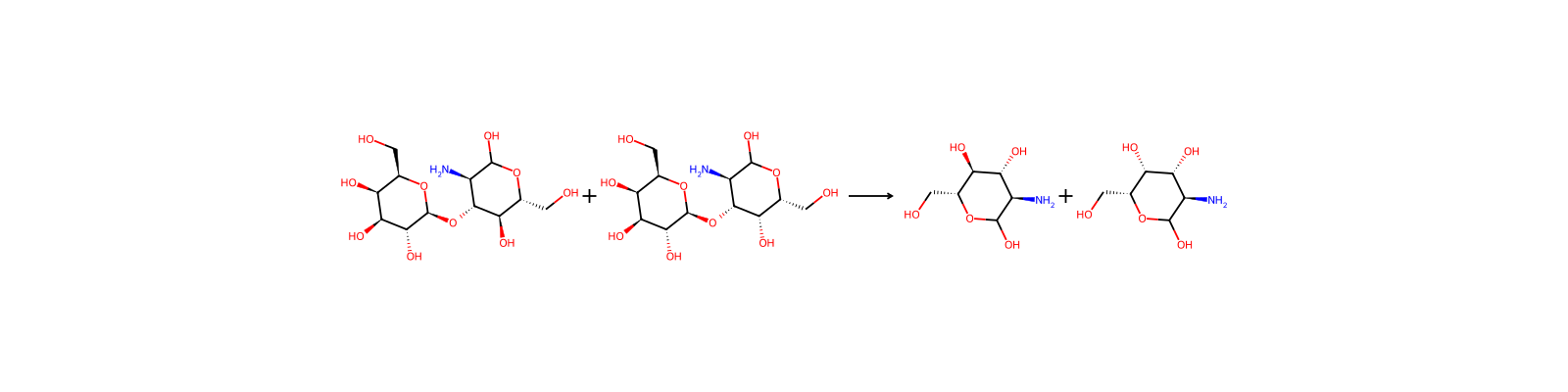
[O:1]([C@H:13]1[C@H:19]([OH:20])[C@@H:18]([CH2:21][OH:22])[O:17][CH:15]([OH:16])[C@@H:14]1[NH2:23])[C@@H]1O[C@H](CO)[C@H](O)[C@H](O)[C@H]1O.[O:24]([C@H:36]1[C@@H:42]([OH:43])[C@@H:41]([CH2:44][OH:45])[O:40][CH:38]([OH:39])[C@@H:37]1[NH2:46])[C@@H]1O[C@H](CO)[C@H](O)[C@H](O)[C@H]1O>>[OH:16][CH:15]1[O:17][C@H:18]([CH2:21][OH:22])[C@@H:19]([OH:20])[C@H:13]([OH:1])[C@H:14]1[NH2:23].[OH:39][CH:38]1[O:40][C@H:41]([CH2:44][OH:45])[C@H:42]([OH:43])[C@H:36]([OH:24])[C@H:37]1[NH2:46]Participants
4


Procedure
Example 3-Synthesis of Galβ1-3GlcNH2 βSEt and Galβ1-3GalNH2 βSEt. See example 1, similar conditions and enzyme may be used, but instead GlcNH2 βSEt, or GalNH2 βSEt to obtain the latter product, is used as the acceptor. Here, extraction is less favorable for isolation, and instead ion-exchanger as above may be used followed by e.g. precipitation or a second chromatographic step.
Sources & evidence
- ORD record
- ord-5ef8e7d94c794f6c9be4623ae826bc31
- Source dataset
- uspto-grants-1999_01
- Patent number
- US05856143
Linked notes
Loading…