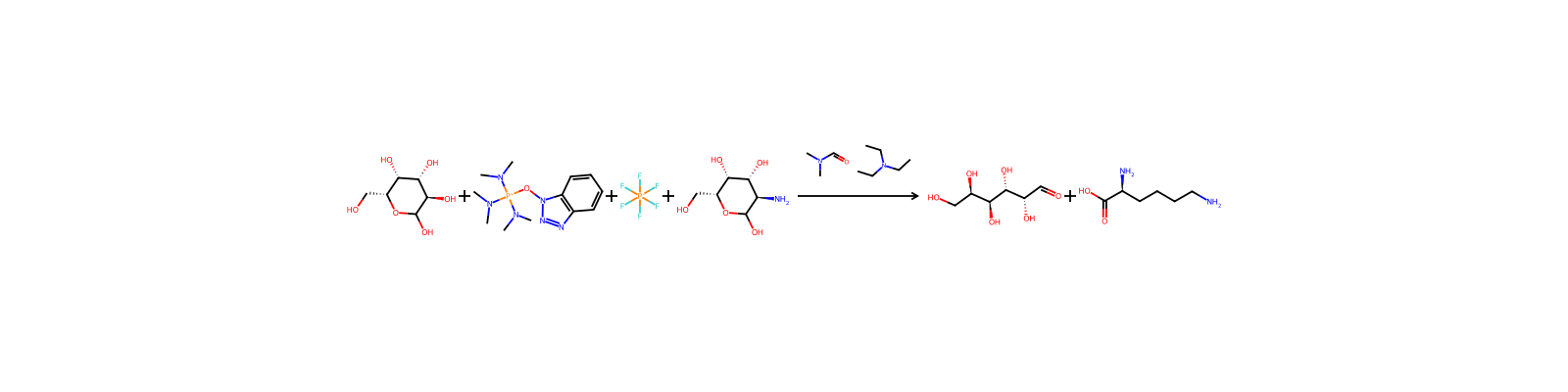

Basic information
- CAS
7535-00-4- Standard SMILES
N[C@H]1C(O)O[C@H](CO)[C@H](O)[C@@H]1O- InChIKey
MSWZFWKMSRAUBD-GASJEMHNSA-N- Molecular formula
- C6H13NO5
- Average molar mass
- 179.17 g/mol
- Monoisotopic mass
- 179.07937252
Overview
2-amino-2-deoxy-D-galactopyranose is the pyranose form of D-galactosamine. It has a role as a toxin. It is a D-galactosamine and a primary amino compound. It is functionally related to a D-galactopyranose. It is a conjugate base of a 2-ammonio-2-deoxy-D-galactopyranose.
Names & identifiers
- Preferred name
- D-Galactosamine
- IUPAC
- (3R,4R,5R,6R)-3-amino-6-(hydroxymethyl)oxane-2,4,5-triol
- English name
- D-Galactosamine
- Molecular formula
- C6H13NO5
- Molecular weight
- 179.17
Names & synonyms
D-GalactosamineGALACTOSAMINE2-Amino-2-deoxy-D-galactopyranoseChondrosamineD-GalNgaln2-Amino-2-deoxy-D-galactoseDTXSID70438712-Deoxy-2-Amino-D-Galactopyranose2-amino-2-deoxy-galactose2-Deoxy-2-Amino-Galactose2-deoxy-2-amino-d-galactose
Show more names
C02262D-Chondrosamined-2-amino-2-deoxygalactoseD-Galactose, 2-amino-2-deoxy-2-Amino-2-deoxy-D-galactose-7535-00-4(2R,3R,4R,5R)-2-Amino-3,4,5,6-tetrahydroxyhexanal
CHEBI:28328CHEBI:603122-Amino-2-Deoxy-Galactopyranose2-Deoxy-2-Amino-Galactopyranose2-amino-2-deoxy-galactopyranoside2-Deoxy-2-Amino-Galactopyranoside2-amino-2-deoxy-d-galactopyranoside2-Deoxy-2-Amino-D-Galactopyranoside
Database identifiers
- CAS
7535-00-4、90-76-6- PubChem CID
- 24154
- DTXSID
DTXSID7043871- ChEMBL
CHEMBL3304228- ChEBI
CHEBI:60312- Nikkaji
- J774.534F
Properties
Computed structural properties
- XLogP
- -2.8
- Topological polar surface area
- 116 Ų
- Hydrogen bond donors
- 5
- Hydrogen bond acceptors
- 6
- Rotatable bonds
- 1
- Heavy atoms
- 12
- Formal charge
- 0
- Complexity
- 155
Physicochemical properties
- Melting point
- 185 °C · 185 °C
- Boiling point
- 532.5 · 532.5±50.0 °C(Predicted)
- Density
- 1.491 · 1.491±0.06 g/cm3(Predicted)
- storage temp.
- 2 · under inert gas (nitrogen or Argon) at 2–8 °C
- solubility
- Soluble (water), slightly soluble (ethanol)
- pka
- 11.21 · 11.21±0.45(Predicted)
- optical activity
- 124 · Alpha form +124 → +93 Beta form +47 → +93
- FDA UNII
- 4 Y6R29688W · 4Y6R29688W
- Symbol(GHS)
- 7 · GHS07
- Signal word
- Warning
- Hazard statements
- 317 · H317-H319
- Precautionary statements
- 280 · P280-P305+P351+P338
Safety & regulation
Safety data
- Signal word
- Warning
- Symbol(GHS)
- GHS07
- Hazard statements
- H317-H319
- Precautionary statements
- P280-P305+P351+P338
Chemistry & industry
Applications
DescriptionGalactosamine is a model hepatotoxicant, induces hepatitis characterized by neutrophilic infiltration, and kills the animal by fulminant hepatic failure. Galactosamine, an amino derivative of sugar galactose, has been used as a model hepatotoxicant since the first reports of hepatotoxicity in late 1970s by Keppler and associates. Galactosamine-induced hepatitis has been a model of choice to study various aspects of liver disease, including mechanisms of toxicant-induced apoptosis and necrosis, liver tissue repair, neutrophil infiltration and transmigration, and the role of endotoxin or lipopolysaccharide (LPS) in initiating liver injury. Humans and animals synthesize galactosamine in the body. Galactosamine (a type of hexosamine) is formed when an amino group replaces one of the hydroxy groups of a sixcarbon sugar, or hexose. The human body utilizes uridine diphosphate (UDP)-N-acetyl-D-glucosamine or glucosamine as a precursor to synthesize this compound, and is most often found in the form N-acetyl-D-galactosamine (often referred to as N-acetylgalactosamine). Most importantly, galactosamine is a constituent of hyaluronic acid, a powerful water-binding agent. Many different types of tissues in human body contain hyaluronic acid, which acts as a lubricating agent in the synovial fluid of joints and in connective tissues. Hyaluronic acid also acts as a lubricating agent in the vitreous humor of the eyeball. Hyaluronic acid has considerable medicinal value; it is often used in wound healing, burn dressings, osteoarthritis treatment, cataract or corneal transplantation surgery, and various types of plastic surgeries.
Suppliers14 total
湖南韵邦生物科技股份有限公司85561037 15386497078 · [email protected]
湖北万得化工有限公司15377098680 15377098680 · [email protected]
杭州璟皓生物科技有限公司(原河南辛迪加生物)17513242016 · [email protected]
湖北广奥生物科技有限公司027-02702759223056 18162699093 · [email protected]
北京秦岭医药科技有限公司010-61241352 18901327973 · [email protected]
上海一飞生物科技有限公司021-65675885 18964387627 · [email protected]
上海源叶生物科技有限公司13636370518 · [email protected]
成都标样生物科技有限公司028-81700200 13308200041 · [email protected]
Watson Biotechnology Co.,Ltd+86-18186686046 · [email protected]
江苏艾康生物医药研发有限公司025-66113011 19370895928 · [email protected]
济南尚博医药股份有限公司0531-61320525 15866703830 · [email protected]
济南尚博生物科技有限公司+8615866703830 · [email protected]
武汉福鑫化工有限公司027-59207852 13308628970 · [email protected]
Wuhan Fortuna Chemical Co., Ltd+86-27-59207850 · [email protected]
Additional notes
DefinitionChEBI: The pyranose form of D-galactosamine.
Related reactions
10 records



Compound notes
Loading…