Reaction equation

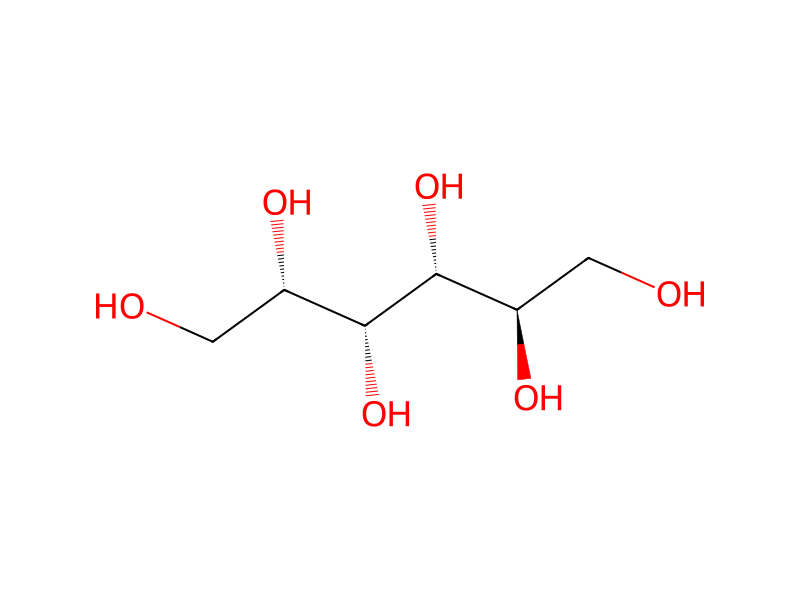
[OH:1][CH2:2][C@@H:3]([C@H:5]([C@@H:7]([C@@H:9]([CH2:11][OH:12])[OH:10])[OH:8])[OH:6])[OH:4].[Cl-].[Cl:14]CC(O)[CH2:17][N+:18](C)([CH3:20])[CH3:19].[OH-].[Na+]>>[Cl-:14].[OH:1][CH2:2][CH2:3][CH2:5][N+:18]([CH3:20])([CH3:19])[CH3:17].[OH:12][CH2:11][C@@H:9]([C@H:7]([C@@H:5]([C@@H:3]([CH2:2][OH:1])[OH:4])[OH:6])[OH:8])[OH:10]Participants



Procedure
Herein is provided a synthesis procedure for the chloride salt of hydroxypropyltrimonium sorbitol (also referred to as ‘Sorbitol Monoquat’). A round bottom 250 ml flask was fitted with a mechanical stirrer. Into the flask was charged a mixture of sorbitol (10 g, 55.0 mmol) and 3-chloro-2-hydroxypropyl trimethylammonium chloride (Quat 188®) (15 ml, 55.0 mmol). One molar sodium hydroxide (55.0 ml, 55.0 mmol) was then added to the charged mixture. The resultant solution was stirred at room temperature for 18 hours. Water was then removed under reduced pressure at 50° C. yielding a heterogeneous colorless syrup. Filtration through glass wool afforded sorbitol hydroxypropyltrimethylammonium chloride as a homogeneous clear syrup: m/z (ESI; M+−Cl−) 298.
Workup
- customHerein is provided
- customA round bottom 250 ml flask was fitted with a mechanical stirrer
- additionInto the flask was charged
- customWater was then removed under reduced pressure at 50° C.
- customyielding a heterogeneous colorless syrup
- filtrationFiltration through glass wool
Sources & evidence
- ORD record
- ord-ba2eb52636ab420ebb67a158eb09807f
- Source dataset
- uspto-grants-2007_02
- Patent number
- US07176172B2
Linked notes
Loading…