Reaction equation
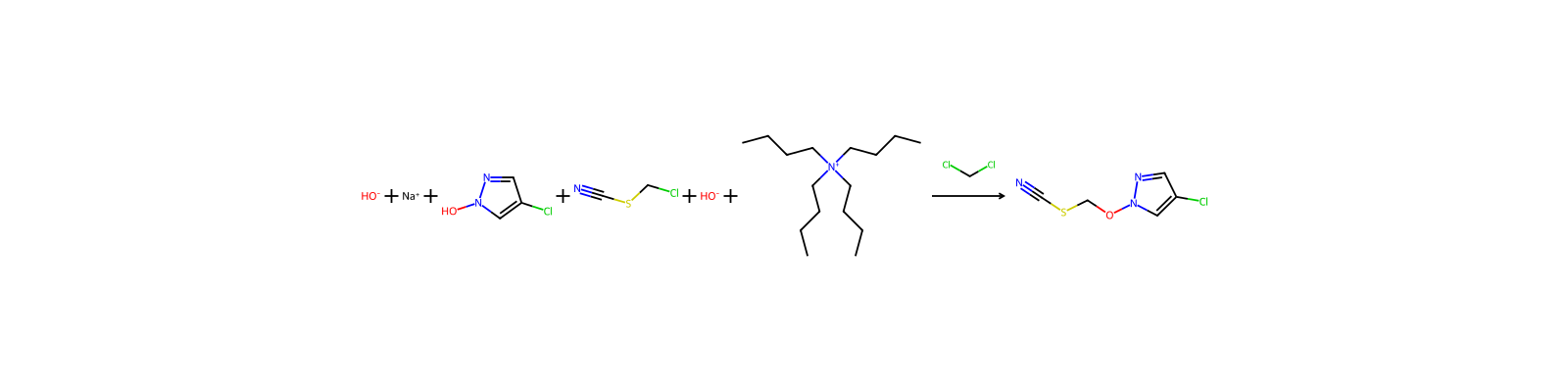
[OH-].[Na+].[Cl:3][C:4]1[CH:5]=[N:6][N:7]([OH:9])[CH:8]=1.Cl[CH2:11][S:12][C:13]#[N:14].[OH-].C([N+](CCCC)(CCCC)CCCC)CCC>C(Cl)Cl>[Cl:3][C:4]1[CH:5]=[N:6][N:7]([O:9][CH2:11][S:12][C:13]#[N:14])[CH:8]=1Participants
6
Reactant 4



Product 1

Reagents, catalysts & solvents 1

Procedure
50 ml of a 5% strength aqueous sodium hydroxide solution were added to 5 g (42 mMol) of 4-chloro-1-hydroxypyrazole, 13.5 g (126 mMol) of chloromethyl thiocyanate and 50 ml of methylene chloride. After the addition of 1 g (4 mMol) of tetra-n-butylammonium hydroxide, the mixture was stirred at room temperature for 24 hours. Thereafter, the organic phase was separated off, dried and evaporated down. Distillation of the residue under reduced pressure (airbath at 140° C./3 mbar) gave 5.7 g (71% of theory) of 4-chloro-1-[(thiocyanato)-methoxy]-pyrazole (compound No. 1), which was recrystallized from ether/petroleum ether (mp. 60° C.).
Workup
- customThereafter, the organic phase was separated off
- customdried
- customevaporated down
- distillationDistillation of the residue under reduced pressure (airbath at 140° C./3 mbar)
Sources & evidence
- ORD record
- ord-e1f2e11ee6ab46f19657e1637b95bd26
- Source dataset
- uspto-grants-1988_08
- Patent number
- US04764527
Linked notes
Loading…