Reaction equation

[CH2:1]([N:8]1[C:12](=O)[CH2:11][CH:10]([C:14](OC)=[O:15])[CH2:9]1)[C:2]1[CH:7]=[CH:6][CH:5]=[CH:4][CH:3]=1.[H-].[Al+3].[Li+].[H-].[H-].[H-]>C(OCC)C>[CH2:1]([N:8]1[CH2:12][CH2:11][CH:10]([CH2:14][OH:15])[CH2:9]1)[C:2]1[CH:7]=[CH:6][CH:5]=[CH:4][CH:3]=1Participants
4
Reactant 2


Product 1
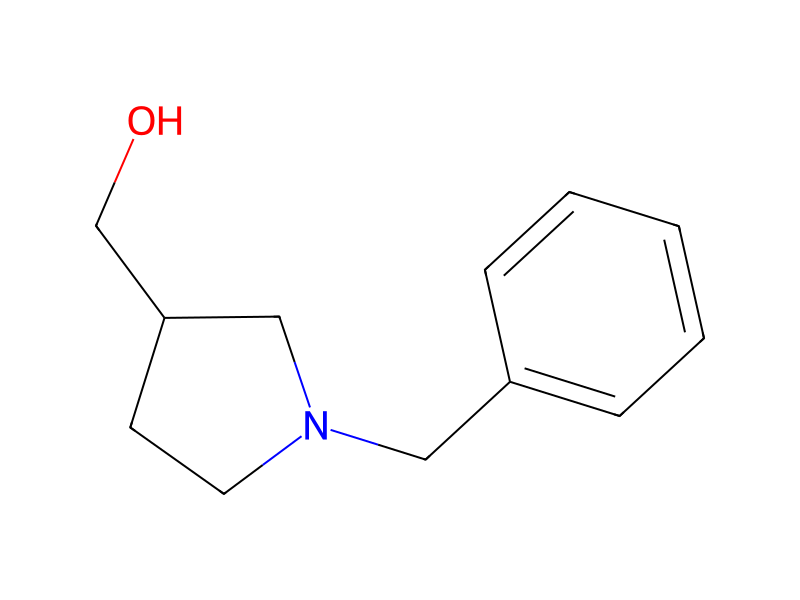
Reagents, catalysts & solvents 1

Conditions
- Temperature
- 0 °C
Procedure
First, N-benzyl-pyrrolidine-3-methanol was prepared as follows. Methyl N-benzyl-5-oxo-pyrrolidine-3-carboxylate (11.66 g, 50 mmol) was dissolved in diethyl ether and cooled to 0° C. This solution was added to a 0° C. suspension of lithium aluminum hydride in diethyl ether under nitrogen atmosphere. After addition, the mixture was refluxed for 1 hr. and then cooled with an ice bath. To quench the reaction, sodium sulfate decahydrate was added and the mixture was stirred for 1 hr. After filtration, the filtrate was collected, and concentrated to dryness to give N-Benzyl-pyrrolidine-3-methanol. ESMS (C12H17NO): calcd. 191.13; obsd. 192–2 [M+H]+. Retention time (anal. HPLC: 10–70% MeCN/H2O over 5 min)=0.95 min.
Workup
- customFirst, N-benzyl-pyrrolidine-3-methanol was prepared
- additionThis solution was added to a 0° C.
- additionAfter addition
- temperaturethe mixture was refluxed for 1 hr
- temperatureand then cooled with an ice bath
- customTo quench
- customthe reaction, sodium sulfate decahydrate
- additionwas added
- filtrationAfter filtration
- customthe filtrate was collected
- concentrationconcentrated to dryness
Sources & evidence
- ORD record
- ord-4af4207eaf724d55ac7e72631be3c989
- Source dataset
- uspto-grants-2007_02
- Patent number
- US07183323B2
Linked notes
Loading…