Reaction equation
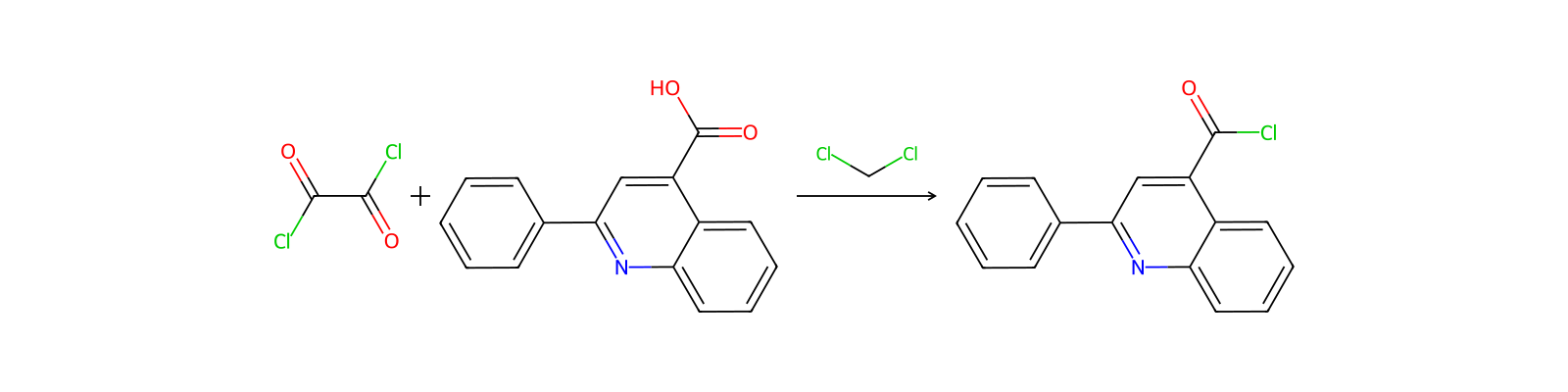
[C:1](Cl)(=O)[C:2]([Cl:4])=[O:3].[C:7]1([C:13]2[CH:22]=C(C(O)=O)[C:20]3[C:15](=[CH:16][CH:17]=[CH:18][CH:19]=3)[N:14]=2)[CH:12]=[CH:11][CH:10]=[CH:9][CH:8]=1>C(Cl)Cl>[C:7]1([C:13]2[CH:22]=[C:1]([C:2]([Cl:4])=[O:3])[C:20]3[C:15](=[CH:16][CH:17]=[CH:18][CH:19]=3)[N:14]=2)[CH:8]=[CH:9][CH:10]=[CH:11][CH:12]=1Participants
4
Reactant 2


Product 1

Reagents, catalysts & solvents 1

Conditions
- Temperature
- -10 °C
Procedure
11.7 ml (136.3 mmol) of oxalyl chloride were dissolved in 150 ml of CH2Cl2. The solution was cooled at −10° C. and 20 g (80.2 mmol) of commercially available 2-phenylquinoline-4-carboxylic acid were added portionwise. The reaction mixture was left overnight at room temperature and then evaporated to dryness to yield 22 g of the title compound, used without further purification.
Workup
- customevaporated to dryness
Sources & evidence
- ORD record
- ord-b95427c06ebb4f998a8b420b3a9d9781
- Source dataset
- uspto-grants-2004_06
- Patent number
- US06743804B2
Linked notes
Loading…