Reaction equation
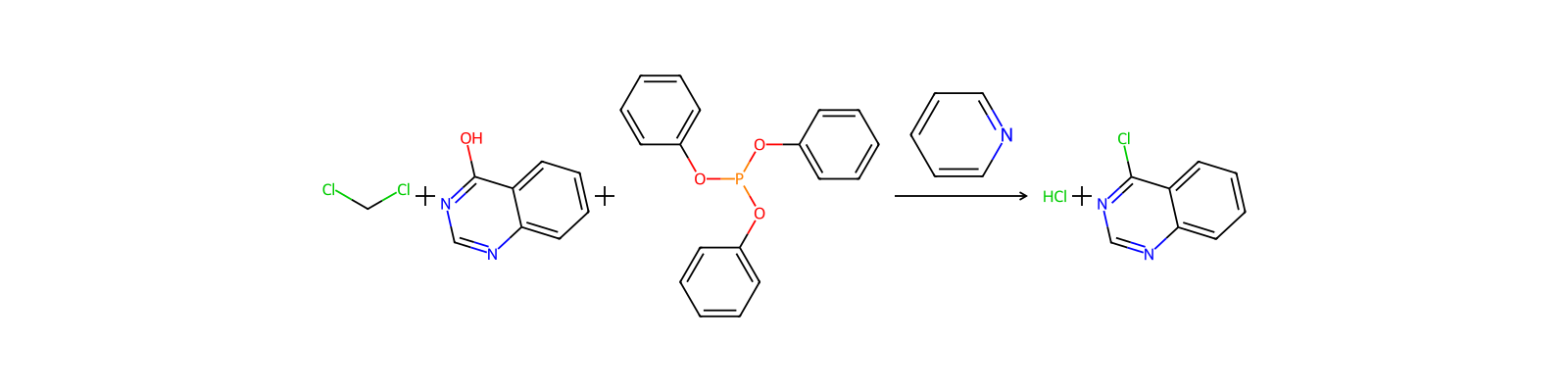
[CH2:1]([Cl:3])[Cl:2].OC1[C:14]2[C:9](=[CH:10][CH:11]=[CH:12][CH:13]=2)[N:8]=[CH:7][N:6]=1.P(OC1C=CC=CC=1)(OC1C=CC=CC=1)OC1C=CC=CC=1>N1C=CC=CC=1>[ClH:2].[Cl:3][C:1]1[C:14]2[C:9](=[CH:10][CH:11]=[CH:12][CH:13]=2)[N:8]=[CH:7][N:6]=1Participants
Reactant 3



Product 1

Reagents, catalysts & solvents 1

Procedure
The compound of Example 2 was prepared on a larger scale, using a preferred process, as follows: To 54 L of methylene chloride, and 1.8 L of pyridine, 6.5 Kg of 4-hydroxyquinazoline was added, and the mixture was cooled to -5° to 10° C. To this mixture 15.7 Kg of triphenyl phosphite was added. Then 3.67 Kg of chlorine gas was bubbled in over a three hour period while the temperature of the mixture was maintained in the range of 0° to 10° C., to produce 4-chloroquinazoline hydrochloride. After stirring the mixture an additional hour, 105 mL of water was added to quench excess halogenating reagent. Then 9.7 Kg of 4-(t-butyl)benzeneethanol was added over a 15 minute period while the mixture was maintained at 10° to 20° C. The mixture was heated to reflux (40°-45° C.) and held at reflux for three hours. After vacuum distilling the contents of the reaction to minimize volume, 56 L of toluene was added. The contents of the reaction were again vacuum distilled, 56 L of heptane were added, and the mixture was cooled to 30°-35° C. The HCl salt of the desired product was isolated by filtration, and washed with toluene/heptane.
Workup
- temperaturethe mixture was cooled to -5° to 10° C
- customThen 3.67 Kg of chlorine gas was bubbled in over a three hour period while the temperature of the mixture
- temperaturewas maintained in the range of 0° to 10° C.
Sources & evidence
- ORD record
- ord-0e46520c518c4a7389a13dc2c9d98083
- Source dataset
- uspto-grants-1995_05
- Patent number
- US05411963
Linked notes
Loading…