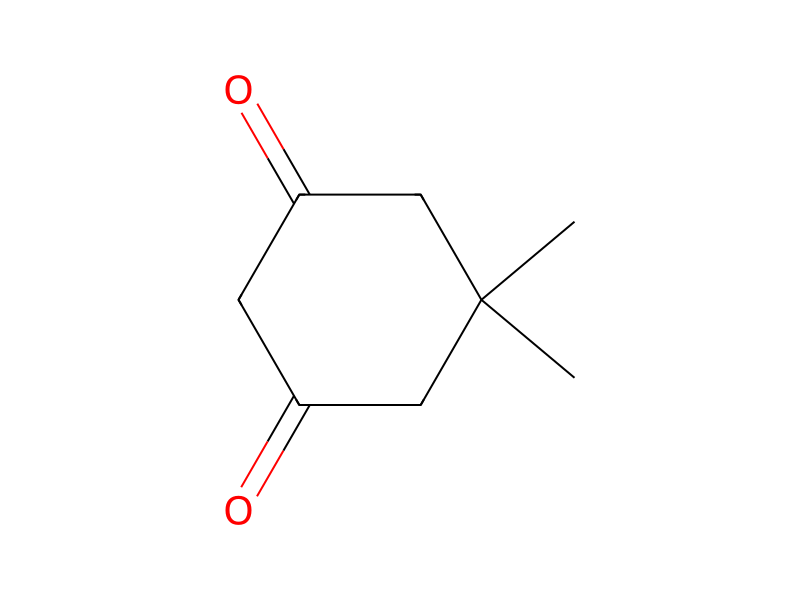
[CH3:1][S:2]([C:5]1[CH:13]=[CH:12][C:8]([C:9](Cl)=[O:10])=[C:7]([N+:14]([O-:16])=[O:15])[CH:6]=1)(=[O:4])=[O:3].C(N(CC)CC)C.[CH3:24][C:25]1([CH3:33])[CH2:30][C:29](=[O:31])[CH2:28][C:27](=[O:32])[CH2:26]1.CC(C)(O)C#N>ClCCl>[CH3:1][S:2]([C:5]1[CH:13]=[CH:12][C:8]([C:9]([CH:28]2[C:29](=[O:31])[CH2:30][C:25]([CH3:33])([CH3:24])[CH2:26][C:27]2=[O:32])=[O:10])=[C:7]([N+:14]([O-:16])=[O:15])[CH:6]=1)(=[O:4])=[O:3]A solution of 4-methylsulphonyl-2-nitrobenzoyl chloride (9.62 g) in dry dichloromethane (50 ml) was added to a stirred solution of triethylamine (5.6 ml) and 5,5-dimethylcyclohexane-1,3-dione (5 g) in dry dichloromethane (70 ml) during 30 minutes and the reaction mixture stirred at ambient temperature for 4 hours. Triethylamine (15.3 ml) and acetone cyanohydrin (0.5 ml) were added successively and the reaction mixture stirred at ambient temperature for 18 hours. The reaction mixture was washed successively with 2N hydrochloric acid (2×50 ml) and water (2×50 ml), dried over magnesium sulphate and evaporated under reduced pressure to give a yellow glass which was recrystallised from methanol (20 ml) to give 2-(4-methylsulphonyl-2-nitrobenzoyl)-5,5-dimethylcyclohexane-1,3-dione (6.4 g), m.p. 156.5°-158° C., as a yellow crystalline solid.
Loading…