Reaction equation
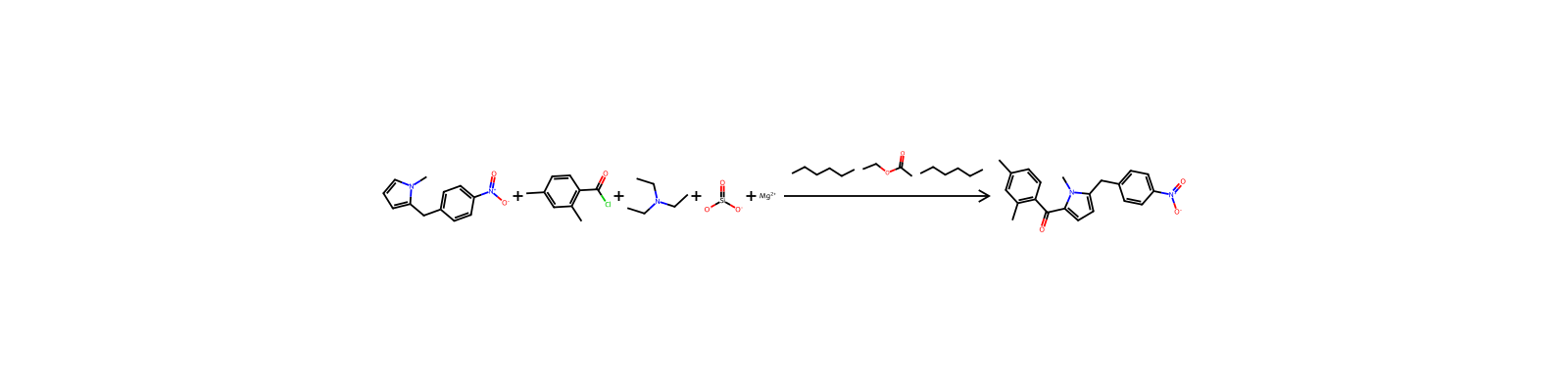
[CH3:1][N:2]1[CH:6]=[CH:5][CH:4]=[C:3]1[CH2:7][C:8]1[CH:13]=[CH:12][C:11]([N+:14]([O-:16])=[O:15])=[CH:10][CH:9]=1.[CH3:17][C:18]1[CH:26]=[C:25]([CH3:27])[CH:24]=[CH:23][C:19]=1[C:20](Cl)=[O:21].C(N(CC)CC)C.[O-][Si]([O-])=O.[Mg+2]>CCCCCC.C(OCC)(=O)C.CCCCCC>[CH3:17][C:18]1[CH:26]=[C:25]([CH3:27])[CH:24]=[CH:23][C:19]=1[C:20]([C:6]1[N:2]([CH3:1])[C:3]([CH2:7][C:8]2[CH:13]=[CH:12][C:11]([N+:14]([O-:16])=[O:15])=[CH:10][CH:9]=2)=[CH:4][CH:5]=1)=[O:21]Participants
7
Reactant 4



Product 1

Reagents, catalysts & solvents 2


Procedure
4-(1-Methylpyrrol-2-ylmethyl)nitrobenzene (1.2 g, 5.5 mmol) [prepared as in Example 7, Step (b)], 2,4-dimethylbenzoyl chloride (1.6 g, 9.5 mmol), and triethylamine (1.3 ml, 9.3 mmol) were dissolved in xylenes (50 ml), and the reaction mixture was heated at reflux under argon. After 48 h, the reaction mixture was passed through a Florisil® column (hexane followed by hexane-ethyl acetate, 95:5) to give 4-{5-(2,4-dimethylbenzoyl)-1-methyl-1H-pyrrol-2-yl-methyl}nitrobenzene (0.81 g, 42%) as a solid. ##STR41##
Workup
- temperaturethe reaction mixture was heated
- temperatureat reflux under argon
Sources & evidence
- ORD record
- ord-c7829573583d4ad3b22599f3337920a0
- Source dataset
- uspto-grants-2000_10
- Patent number
- US06136844
Linked notes
Loading…