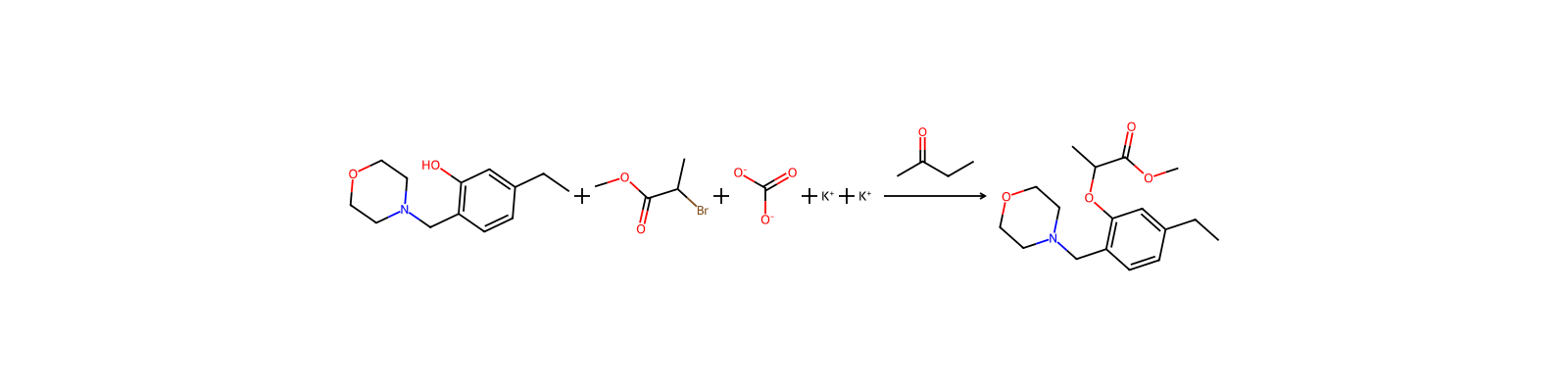
[N:1]1([CH2:7][C:8]2[CH:13]=[CH:12][C:11]([CH2:14][CH3:15])=[CH:10][C:9]=2[OH:16])[CH2:6][CH2:5][O:4][CH2:3][CH2:2]1.Br[CH:18]([CH3:23])[C:19]([O:21][CH3:22])=[O:20].C(=O)([O-])[O-].[K+].[K+]>CC(CC)=O>[N:1]1([CH2:7][C:8]2[CH:13]=[CH:12][C:11]([CH2:14][CH3:15])=[CH:10][C:9]=2[O:16][CH:18]([CH3:23])[C:19]([O:21][CH3:22])=[O:20])[CH2:6][CH2:5][O:4][CH2:3][CH2:2]1To a 250 mL round bottom flask equipped with a mechanical stirrer and a thermometer was added 5.0 grams (0.0.023 mole--1.0 equiv.) of 2-(morpholin-4-ylmethyl)-5-ethylphenol, 4.54 grams (0.027 mole--1.2 equiv.) of methyl 2-bromopropanoate, 3.75 grams (0.027 mole--1.2 equiv.) of potassium carbonate, and 50 mL (%Wt/Vol. Phenol to Solvent--10%) of methylethylketone. The reaction mixture was heated to reflux where it stirred for 27 hours. After this period, the reaction mixture was analyzed by GC, which indicated the reaction was complete. The reaction mixture was filtered and washed with diethylether. The filtrate was concentrated under reduced pressure, yielding 7.0 grams of 96% pure methyl 2-[2-(morpholin4-ylmethyl)-5-ethylphenoxy]propanoate (95.2% yield).