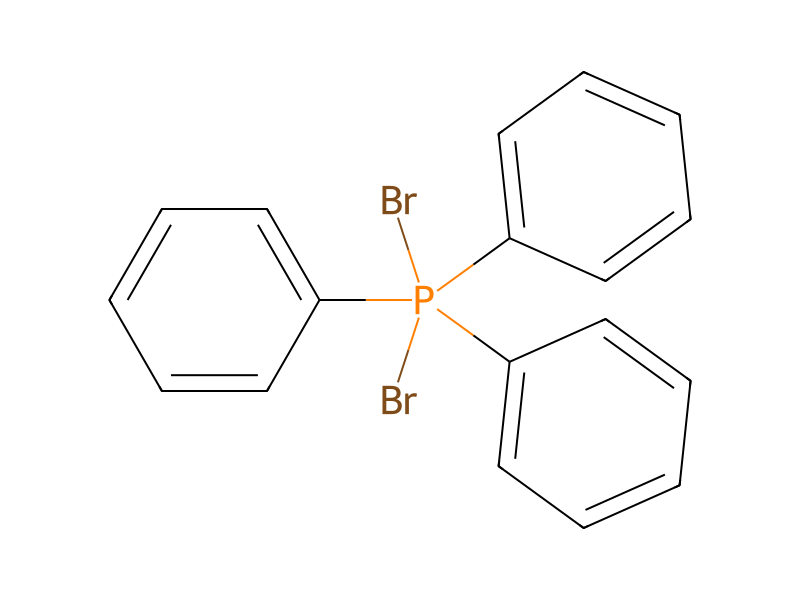
Triphenylphosphine dibromide → 3-Tert-butyl-4-((tert-butyldimethylsilyl)oxy)benzyl bromide
HRID 369822
Reaction equation

[C:1]([C:5]1[CH:6]=[C:7]([CH:10]=[CH:11][C:12]=1[O:13][Si:14]([C:17]([CH3:20])([CH3:19])[CH3:18])([CH3:16])[CH3:15])[CH2:8]O)([CH3:4])([CH3:3])[CH3:2].[Br:21]P(Br)(C1C=CC=CC=1)(C1C=CC=CC=1)C1C=CC=CC=1>C(Cl)Cl>[C:1]([C:5]1[CH:6]=[C:7]([CH:10]=[CH:11][C:12]=1[O:13][Si:14]([C:17]([CH3:20])([CH3:19])[CH3:18])([CH3:16])[CH3:15])[CH2:8][Br:21])([CH3:4])([CH3:3])[CH3:2]Participants
4



Procedure
A 500 mL round-bottomed flask equipped with a magnetic stirrer was charged with 3.6 g of 3-tert-butyl-4-((tert-butyldimethylsilyl)oxy)benzyl alcohol and 25 mL of anhydrous CH2Cl2. The solution was cooled in an ice water bath and was treated with 5.68 g of dibromotriphenylphosphorane (Aldrich). The reaction mixture was warmed to RT, stirred for 2.5 h and then diluted with 100 mL of CH2Cl2. The resulting solution was washed with 5% aqueous NaHCO3 (4×60 mL), dried over anhydrous MgSO4 and concentrated to give a white solid. The crude product was purified by flash chromatography on silica gel (95:5 hexane:EtOAc) to afford 3.86 g (88%) of 3-tert-butyl-4-((tert-butyldimethylsilyl)oxy)benzyl bromide as a white crystalline solid, m.p. 54-55° C.