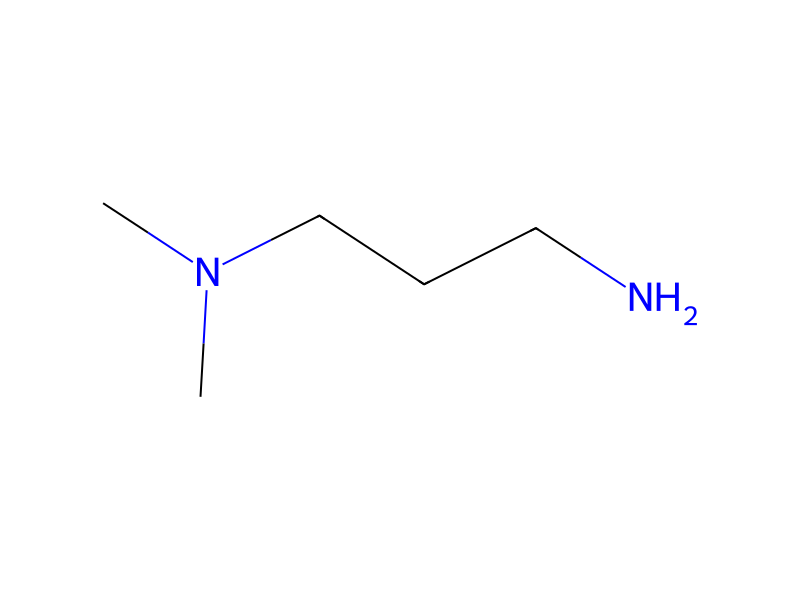
Cl[C:2]1[C:7]([N+:8]([O-:10])=[O:9])=[C:6]([Cl:11])[N:5]=[C:4]([CH3:12])[C:3]=1[C:13]([O:15][CH2:16][CH3:17])=[O:14].CO.[CH3:20][N:21]([CH3:26])[CH2:22][CH2:23][CH2:24][NH2:25]>C(N(CC)CC)C>[CH3:20][N:21]([CH3:26])[CH2:22][CH2:23][CH2:24][NH:25][C:2]1[C:7]([N+:8]([O-:10])=[O:9])=[C:6]([Cl:11])[N:5]=[C:4]([CH3:12])[C:3]=1[C:13]([O:15][CH2:16][CH3:17])=[O:14]139 g. of 4,6-dichloro-2-methyl-5-nitropyridine-3-carboxylic acid, ethyl ester (0.5 Mol.) of Example 1a are dissolved in about 500 ml. of methanol. 60 g. of triethylamine are added and the solution is heated at reflux temperature. At this point, 50.1 g. of [3-(dimethylamino)propyl]amine are added dropwise. After the addition is completed, heating is continued for ten minutes. The solvent is removed in vacuo and the residue is suspended in 200 ml. of water. The aqueous mixture is made alkaline with 10% sodium hydroxide solution and extracted three times with 200 ml. portions of ethyl acetate. The organic layer is dried over calcium chloride, evaporated to dryness and crystallized with petroleum ether to obtain 4-[[3-(dimethylamino)propyl]amino]-6-chloro-2-methyl-5-nitropyridine-3-carboxylic acid, ethyl ester, yield: 102 g. (59%); m.p. 20°.