Reaction equation
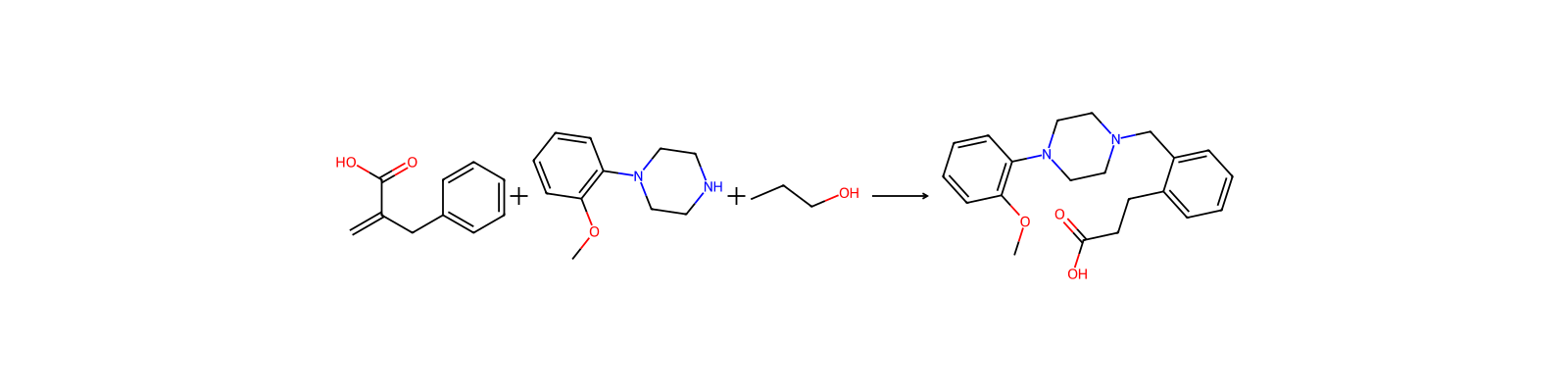
[C:1]1([CH2:7][C:8](=C)[C:9]([OH:11])=[O:10])[CH:6]=[CH:5][CH:4]=[CH:3][CH:2]=1.[CH3:13][O:14][C:15]1[CH:20]=[CH:19][CH:18]=[CH:17][C:16]=1[N:21]1[CH2:26][CH2:25][NH:24][CH2:23][CH2:22]1.[CH2:27](O)CC>>[CH3:13][O:14][C:15]1[CH:20]=[CH:19][CH:18]=[CH:17][C:16]=1[N:21]1[CH2:26][CH2:25][N:24]([CH2:27][C:2]2[C:1]([CH2:7][CH2:8][C:9]([OH:11])=[O:10])=[CH:6][CH:5]=[CH:4][CH:3]=2)[CH2:23][CH2:22]1Participants
4



Procedure
2-(Phenylmethyl)propenoic acid (Mannich and Ganz, Chem. Ber., 1922, 55, 34867) (2.00 g, 12.35 mmol) and 1-(2-methoxyphenyl)piperazine (2.37 g, 12.35 mmol) in propanol (25 ml) were heated under reflux for 18 hours, cooled to room temperature, and evaporated in vacuo. The residue was triturated with acetone and ether to give the product (0.80 g) as a colourless powder, m.p. 155°-158°. (Found: C, 71.6; H, 7.4; N, 7.6. C21H26N2O3 requires C, 71.2; H, 7.3; N, 7.9%.)
Workup
- temperatureunder reflux for 18 hours
- customevaporated in vacuo
- customThe residue was triturated with acetone and ether
Sources & evidence
- ORD record
- ord-0a52dcde0a794f1386fc3d683b184db6
- Source dataset
- uspto-grants-1995_05
- Patent number
- US05420278
Linked notes
Loading…