Reaction equation

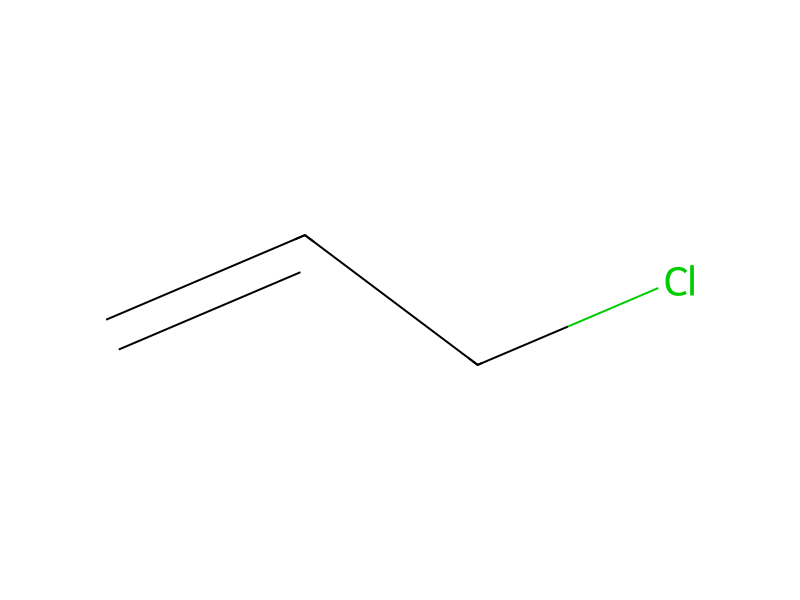
[C:1]1([Na])[CH:6]=[CH:5][CH:4]=[CH:3][CH:2]=1.[Na].Cl[C:10]1[CH:15]=CC=[CH:12][CH:11]=1.C(Cl)C=C.S(=O)(=O)(O)O>C1(C)C=CC=CC=1.C(NC(C)C)(C)C>[C:1]1([CH2:12][CH2:11][CH:10]=[CH2:15])[CH:6]=[CH:5][CH:4]=[CH:3][CH:2]=1Participants







Conditions
- Temperature
- 20 °C
Procedure
A toluene (20 g) solution containing 2.58 g (0.025 mol, 2 mol %) of diisopropylamine was added to phenyl sodium, which had been prepared by reacting 60.0 g (2.610 mol) of sodium dispersion and 144.0 g (1.279 mol) of chlorobenzene in 800 g of toluene, at room temperature (about 20° C.), and then the reaction mixture was stirred for 2 hours. To the resultant greenish brown slurry was added a toluene (40 g) solution containing 98.0 g (1.280 mol) of allyl chloride, keeping the reaction temperature in the range of from -10° C. to 0° C., and then the reaction mixture was allowed to stand, for aging, for 1 hour at room temperature. After the reaction was completed, the reaction mixture was subjected to hydrolysis with 250 ml of sulfuric acid (5%) in the range of 5 to 20° C., and then the resultant solution was allowed to stand, then it was separated. The separated organic layer was washed with 200 ml of water twice, followed by gas chromatography analysis. It was identified that 4-phenyl-1-butene was given, at the yield of 96.4%. Further, the organic layer was condensed by atomospheric distillation, and the residue was further subjected to distillation under reduced pressure at 106° C./105 mmHg, to give 148.0 g of 4-phenyl-1-butene (1.119 mol, yield 87.5% on the basis of chlorobenzene. The term "yield" is hereinafter used in the same meaning as the above), followed by gas chromatography, for purity testing. As a result, it was found that the purity of 4-phenyl-1-butene was 98.7%.
Workup
- customhad been prepared
- customof from -10° C. to 0° C.
- waitfor aging, for 1 hour at room temperature
- customit was separated
- washThe separated organic layer was washed with 200 ml of water twice
- customcondensed
- distillationby atomospheric distillation
- distillationthe residue was further subjected to distillation under reduced pressure at 106° C./105 mmHg
Sources & evidence
- ORD record
- ord-0f4901cf5ca246658a170561cbc81d47
- Source dataset
- uspto-grants-2000_02
- Patent number
- US06024897
Linked notes
Loading…