Phosphorus oxide (P4O10) → Dithieno[2,3-d:2',3'-d']benzo[1,2-b:4,5-b']dithiophene
HRID 384245
Reaction equation

C[S:2]([C:4]1[CH:9]=[C:8]([C:10]2[S:14][C:13](CCC)=[CH:12][CH:11]=2)[C:7]([S:18](C)=O)=[CH:6][C:5]=1[C:21]1[S:25][C:24](CCC)=[CH:23][CH:22]=1)=O.O=P12OP3(OP(OP(O3)(O1)=O)(=O)O2)=O.FC(F)(F)S(O)(=O)=O>>[S:14]1[C:10]2[C:8]3[CH:9]=[C:4]4[S:2][C:22]5[CH:23]=[CH:24][S:25][C:21]=5[C:5]4=[CH:6][C:7]=3[S:18][C:11]=2[CH:12]=[CH:13]1Participants
4

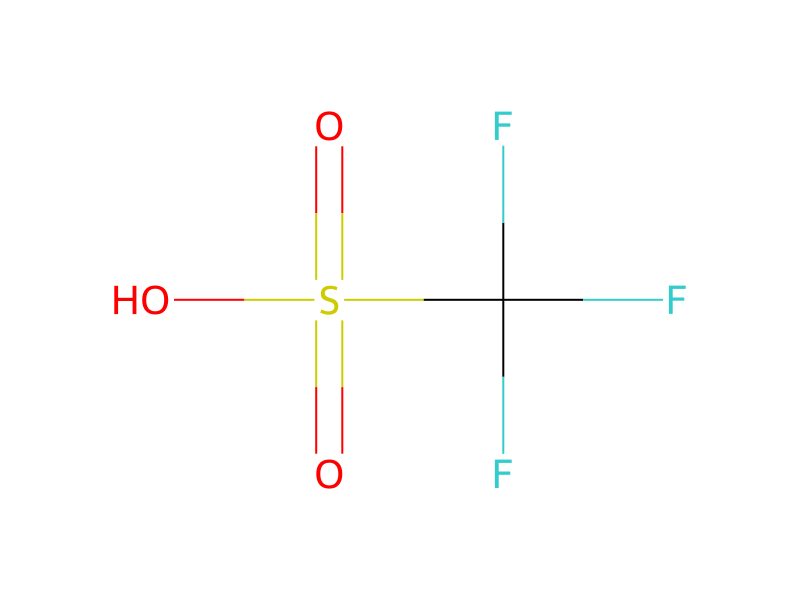


Procedure
A round bottomed flask was filled with 5,5′-(2,5-bis(methylsulfinyl)-1,4-phenylene)bis(2-propylthiophene) (2c) (1.0 g, 2.2 mmol), phosphorus pentoxide (0.1 g, 0.703 mmol) and trifluoromethanesulfonic acid (20 ml). The mixture was stirred for 72 h at room temperature to give a dark brown solution, which was then poured into ice-water (120 ml). The yellow precipitate was collected by suction filtration and dried under vacuum. The structure of this compound, which was insoluble in apolar organic solvents, was assumed to be the sulfonium salt. Demethylation of the solid was achieved by refluxing it in pyridine (167 ml) for 12 h. When the suspension was cooled to room temperature, a large volume of CH2Cl2 was added to extract the product. Dithieno[2,3-d:2′,3′-d′]benzo[1,2-b:4,5-b′]dithiophene (1c) was thus obtained as off-white powder by hexane as an eluent and recrystalised in dichloromethane (370 mg, 43%).