HomeMCPWorkbenchSkills
HomeWorkbenchNotificationsMe
llms.txt · MCP GuidePrivacy Policy · Terms of Service · Supportv1.8.3
  1. Home
  2. /Reaction

Potassium Carbonate → 3-(2,2-Dimethyl-1,1-dioxidotetrahydro-2H-thiopyran-4-yl)-5-[5-(1-pyrrolidinylsulfonyl)-2-thienyl]-1H-indole-7-carboxamide

HRID 387388
Print

Reaction equation

HRID 387388 reaction equation
[CH3:1][C:2]1([CH3:31])[CH2:7][CH:6]([C:8]2[C:16]3[C:11](=[C:12]([C:26]([NH2:28])=[O:27])[CH:13]=[C:14](B4OC(C)(C)C(C)(C)O4)[CH:15]=3)[NH:10][CH:9]=2)[CH2:5][CH2:4][S:3]1(=[O:30])=[O:29].Br[C:33]1[S:37][C:36]([S:38]([N:41]2[CH2:45][CH2:44][CH2:43][CH2:42]2)(=[O:40])=[O:39])=[CH:35][CH:34]=1.C(=O)([O-])[O-].[K+].[K+]>O1CCOCC1.O.C1C=CC(P(C2C=CC=CC=2)[C-]2C=CC=C2)=CC=1.C1C=CC(P(C2C=CC=CC=2)[C-]2C=CC=C2)=CC=1.Cl[Pd]Cl.[Fe+2].C(Cl)Cl>[CH3:1][C:2]1([CH3:31])[CH2:7][CH:6]([C:8]2[C:16]3[C:11](=[C:12]([C:26]([NH2:28])=[O:27])[CH:13]=[C:14]([C:33]4[S:37][C:36]([S:38]([N:41]5[CH2:45][CH2:44][CH2:43][CH2:42]5)(=[O:39])=[O:40])=[CH:35][CH:34]=4)[CH:15]=3)[NH:10][CH:9]=2)[CH2:5][CH2:4][S:3]1(=[O:30])=[O:29]
ParticipantsConditionsProcedureWorkupSources & evidenceReaction notes

Participants

7

Reactant 3

HCID 11430Potassium CarbonateHCID 8939391-[(5-Bromo-2-thienyl)sulfonyl]pyrrolidineHCID 593327993-(2,2-Dimethyl-1,1-dioxidotetrahydro-2H-thiopyran-4-yl)-5-(4,4,5,5-tetramethyl-1,3,2-dioxaborolan-2-yl)-1H-indole-7-carboxamide

Product 1

HCID 593326763-(2,2-Dimethyl-1,1-dioxidotetrahydro-2H-thiopyran-4-yl)-5-[5-(1-pyrrolidinylsulfonyl)-2-thienyl]-1H-indole-7-carboxamideYield 21.4%

Reagents, catalysts & solvents 3

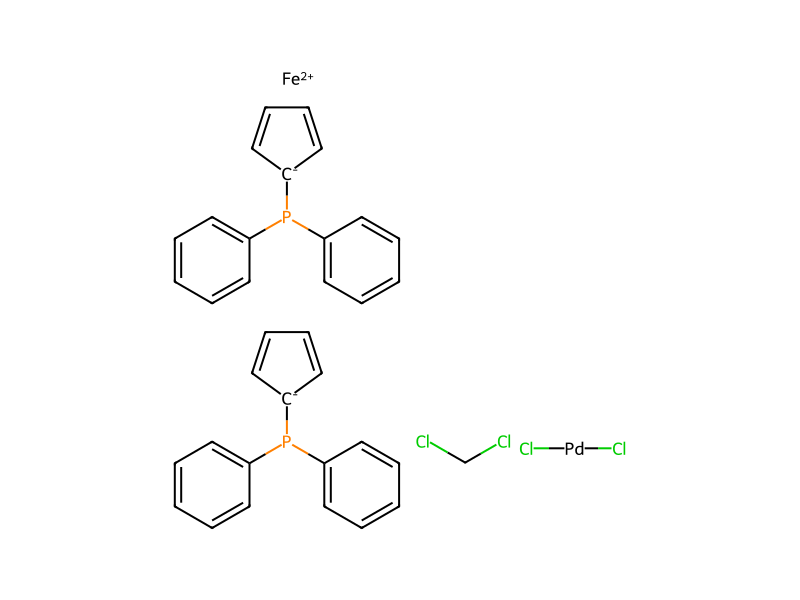
HCID 178418807HCID 178418807, compoundCatalystHCID 962WaterSolventHCID 312751,4-DioxaneSolvent

Conditions

Temperature
100 °C

Procedure

3-(2,2-Dimethyl-1,1-dioxidotetrahydro-2H-thiopyran-4-yl)-5-(4,4,5,5-tetramethyl-1,3,2-dioxaborolan-2-yl)-1H-indole-7-carboxamide (75 mg, 0.17 mmol), 1-[(5-bromo-2-thienyl)sulfonyl]pyrrolidine (60 mg, 0.17 mmol, 1 eq), PdCl2(dppf)-CH2Cl2 adduct (20 mg, 0.024 mmol, 0.15 eq), and potassium carbonate (100 mg, 0.72 mmol, 4.3 eq) were diluted in a mixture of 1,4-dioxane (3 mL) and water (1.5 mL) in a 2-5 mL microwave tube. The mixture was degassed by bubbling argon through for 5 minutes, then heated in a biotage microwave at 100° C. for 5 minutes. The crude reaction mixture was filtered through a thiol SPE cartridge (polymer labs) to remove palladium, and concentrated. The residue was dissolved in ˜3 mL of dmso, and filtered. The crude product was purified by ammonium hydroxide Gilson hplc, and the desired fractions were evaporated. The product was further purified by trituration from diethyl ether to afford 19.5 mg (21%) of the title compound.

Workup

  1. customThe mixture was degassed
  2. customby bubbling argon through for 5 minutes
  3. customThe crude reaction mixture
  4. filtrationwas filtered through a thiol SPE cartridge (polymer labs)
  5. customto remove palladium
  6. concentrationconcentrated
  7. dissolutionThe residue was dissolved in ˜3 mL of dmso
  8. filtrationfiltered
  9. customThe crude product was purified by ammonium hydroxide Gilson
  10. customthe desired fractions were evaporated
  11. customThe product was further purified by trituration from diethyl ether

Sources & evidence

ORD record
ord-54fac488594841a2b0e59d8cdf1e6100
Source dataset
uspto-grants-2013_02
DOI
10.6084/m9.figshare.5104873.v1
Patent number
US08372875B2

Reaction notes

On this pageParticipantsConditionsProcedureWorkupSources & evidenceReaction notes